The Church often claims that Jesus Christ established a system. By “system” is meant the church as an institution: a structure of authority, succession, a hierarchy and a set of mandatory forms. That claim has become almost an axiom. It is rarely questioned. More often it is inherited. But if you set aside the customary ecclesiastical language and turn to the texts, to history, and to human experience itself, the picture looks different.
Jesus did not leave a system. He left a direction. He set a way of life, not a form of organization. He set a tone, not a detailed score. That distinction is crucial.
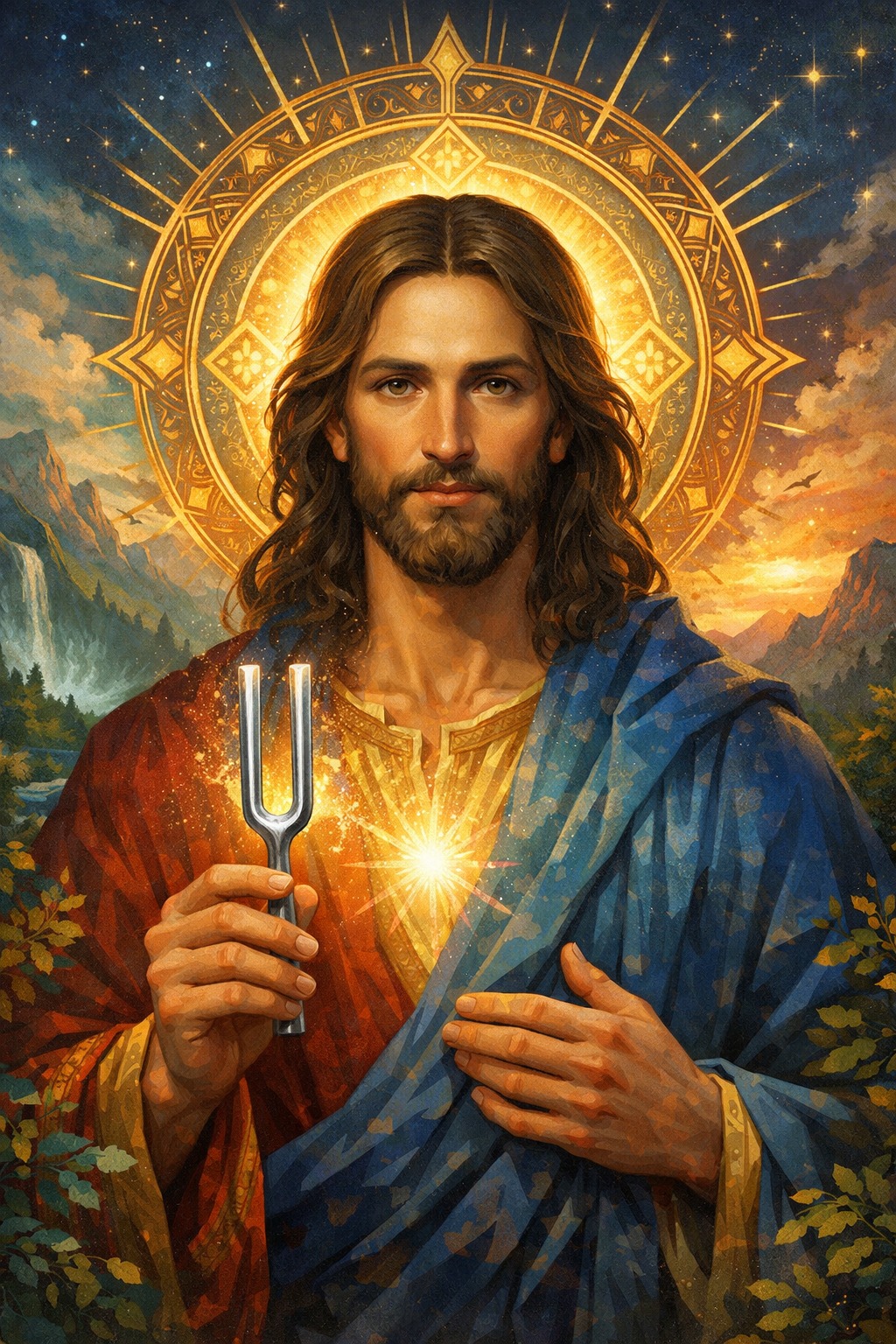
Picture a simple image: a tuning fork. A small metal instrument. It does not make music. It does not build an orchestra. It does not explain how to make violins or pianos. It simply rings if you strike it lightly. And if there is a string nearby tuned close to that frequency, it begins to sound with it — with no order, no instruction, no transfer of authority. That is called resonance.
In the gospel texts there is no charter. No governance blueprint. No job descriptions. No liturgical regulations. No procedure for transferring power. No instruction for exactly what a community should look like after Jesus’ departure. That does not look like forgetfulness. It looks like principle. Jesus talks about fear and trust, about life and death, about freedom and truth, about the inner person. He does not talk about structure. He does not talk about mechanisms. He does not talk about a system.
If Jesus had intended to create a durable institutional form, the absence of such instructions would be strange. In that case instructions would have been decisive. But we see the opposite. We see a steady reluctance to formalize. We see a language of images, parables and paradoxes. We see a call to an internal choice rather than to an external arrangement.
A tuning fork does not explain how to live. It simply sets the frequency. Life either responds or it does not.
Jesus’ words consistently undermine systemic thinking. He says the Kingdom does not arrive in an obvious, outward way. He says it is within a person. He forbids the fixing of titles and statuses. He upends hierarchy, naming first the one who serves. Systems are built on control, boundaries and visible power. These words destroy the very logic of control.
A tuning fork does not govern the string. It does not check documents. It does not demand loyalty. It simply vibrates.
After Jesus’ death many forms emerge. The Jerusalem community lives one way. The communities associated with Paul live another. The Johannine tradition speaks its own language. Judeo-Christians remain closer to the Law. Gnostic groups seek a different path. Disputes flare up among these groups over meaning, path and way of life. But none of the sides opens a document titled “Instructions of Jesus.” No one cites a charter. No one says, “This is what Jesus said about structure.”
Each group hears the original frequency differently. Each tries to tune itself. Somewhere the sound is pure. Somewhere it goes flat. This is not a sign of chaos. It is a sign of the absence of a rigid form. If an instruction had existed, diversity would have lost its point. The tuning fork is one; the strings are many. The sound is never identical.
People often appeal to the apostles, especially Peter, to defend the idea of a system. But apostleship in early Christianity does not look like an office. It does not look like a bureau. It is not administrative power. Peter does not create a managerial model. He does not leave regulations. He does not build an apparatus. Peter’s role is witness. His role is care and living presence. The language of shepherding reads like an image, not an instruction. It is the language of relationships, not of governance. Again: the language of resonance.
A tuning fork does not transfer authority. It transmits a sound.
Systems arise later. They appear decades and centuries on, not out of revelation but out of human necessity. Any movement follows a similar path. First there is charisma. Then the source dies. Then fear of loss sets in. Then a desire to preserve emerges. Then a structure forms. This is not a sin or a conspiracy. It is a natural reaction of people who want to preserve meaning and are unwilling to lose it. Systems solve survival problems. They keep memory. They defend boundaries. They create order. But they are not equal to the source. They are not equal to Jesus. They are an answer to absence, not His design.
The tuning fork is needed to set the tone. The orchestra comes later. Sometimes it loses the pitch. Sometimes it plays so loudly it drowns out the original sound.
Yet the strongest argument is not in the texts and not in history, but in existential experience. Jesus does not appeal to tradition. He does not justify himself by institutions. He does not demand belonging. He addresses the person directly. His words are either recognized or not. His presence either resonates or remains foreign.
Following Jesus does not look like joining an organization. It looks like tuning. A person either hears that tone or does not. It cannot be imposed. It cannot be passed down by inheritance. It cannot be guaranteed by formal succession. A tuning fork does not prove who is right. It checks the tuning.
The Church speaks of succession as a line of transferred authority. Jesus speaks of succession as similarity of life. Formal continuity does not guarantee closeness. Antiquity of form does not guarantee harmony. True succession is measured not by documents but by sound.
A string may be new. It may be old. If the frequency matches, the sound appears.
Jesus did not create a system. He did not leave instructions. He did not pass on powers. He set a direction and left freedom. He became the measure, not the source of power. He became the criterion of authenticity, not the guarantor of form. The Church remains an attempt to preserve that sound — sometimes deeply, sometimes traumatically, sometimes accurately, sometimes distorted. Its value is determined not by scale or power but by the degree of its resonance with that original tone. Jesus is not the architect of a system. He is a tuning fork. Everything else is instrument. And each instrument made by human hands is defined by whether or not it sounds at that frequency.













 Follow Jesus Christ
Leave a comment