
If I love, for example, a state or religious order, then my conversation with its ministers will be reduced to praise and dithyrambs, expression of bright feelings and loyal mood. What could thirteen-year-old Jesus talk about with the scribes and priests in Jerusalem? The conversation was certainly diplomatic, but its root was the disagreement between Jesus and the priests of the Jewish cult. There were no dithyrambs. This conclusion can be made on the basis of Jesus’s further words and the priests’ attitude towards Him. Jesus did not like the temple religious system in Jerusalem. His respectful questions and answers were reduced to pointing out the ideas that He openly expressed many years later.
There are many words of Jesus that can be cited as evidence. For example, “Go and learn what this means: ‘I desire mercy, and not sacrifice’,” “My house shall be called a house of prayer, but you have made it a den of thieves,” “The hour is coming when you will neither worship the Father on this mountain nor in Jerusalem… God is a spirit, and those who worship Him must worship in spirit and in truth.” Or the phrase “To love God with all your heart… and your neighbor as yourself is more than all burnt offerings and sacrifices”: it was said by a scribe, but Jesus approves of this statement. The apogee of the conflict between Jesus and Temple Judaism was the expulsion of merchants from the temple.
Initially, trade took place outside the temple – on the slopes of the Mount of Olives or in the Kidron Valley. One of the reasons why trade was moved to the temple courtyard for the pagans was the chaos of the influx of pilgrims, when thousands of people dragged animals on ropes to the temple through narrow streets. However, there was another reason: corruption. The official version could sound like this: “We moved trade inside the temple for the convenience of pilgrims and the purity of the ritual.” But in fact, this eliminated competitors outside the temple, gave the priests a profit from each purchase and made religion part of the financial system. Annas (Hanan), a former high priest, Caiaphas’s father-in-law, wielded enormous influence. His family controlled the market known as “Anna’s market.” According to the Talmud, they were nicknamed “Anna’s family – the teeth of jackals,” for their greed and ruthlessness. Moving trade inside the temple gave monopoly control over the whole process – who sells, what prices, guaranteed income (taxes, “certification” of animals, commissions), power: anyone who brought an animal himself could be refused without explanation. These are the opponents Jesus dealt with. From this point of view, it was these corrupt officials who caused Jesus’ death.
If desired, one can find places in the Gospels where Jesus does not theoretically condemn sacrifices. For example, “The scribes and Pharisees sit in Moses’ seat: therefore whatever they tell you to observe, that observe and do…”, or “If you bring your gift to the altar, and there remember that your brother has something against you, leave your gift there before the altar, and go and first be reconciled to your brother…”. However, upon closer examination, these words should be understood as permission for uneducated people, and not as a commandment for everyone. Jesus ordered his closest disciples to break ties with the Pharisees and priests. Jesus put ethics, love, and inspiration first. As His ministry showed, religion can be organized without any rituals, sacrifices, or complex worship services.
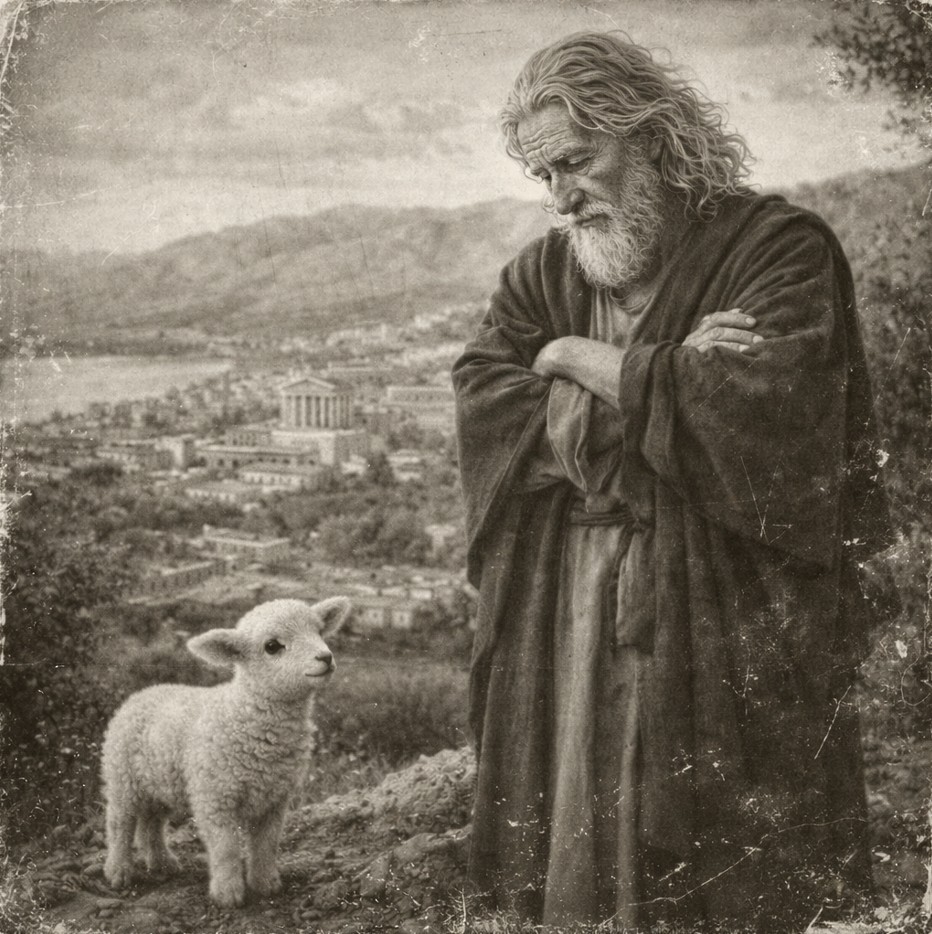
Apparently, in his conversation with the priests and scribes, the thirteen-year-old Jesus was trying to gently convey the idea that worship of God did not require the cumbersome religion that Judaism had built. Jesus came to Jerusalem for his first Passover, as a bar mitzvah, entering adulthood according to Jewish custom. Probably even then he was deeply shocked by the formalism, commercial calculations, and possibly sacrifices in the temple. Does God want such rituals? Blood, the cries of animals, the stench and smoke from burnt meat enveloping the temple. Jesus spent time in dialogue with the rabbis and teachers – not just asking questions, but arguing, disputing, surprising with the depth of his thoughts. At this age, he had an internal spiritual awakening and understanding of his unique calling. Most likely, he suffered greatly internally, seeing religious blindness and hypocrisy.
Jesus was already a revolutionary of the spirit in his youth, but not a destroyer, but an educator: He strives to purify religion, to return it to the true God. His conflict with Judaism began not in adulthood, but in childhood. But He acted with love and patience, not with condemnation. Jesus is an example of early spiritual maturity, where emotional sensitivity is combined with willpower and clarity of purpose. His remark, “I must be about my Father’s business,” is a conscious choice of life’s path, not just a brilliant statement.
The ages of twelve and thirteen are the classic ages of identity integration: the child is searching for who he is in the world. Jesus already had a highly developed morality, self-awareness, and a conscious connection with God as Father. This is an early example of inner autonomy: He does not obediently follow his parents, but follows the “inner Father.” Jesus is not afraid to challenge traditions, even among educated rabbis. This is not a manifestation of adolescent rebellion, but of prophetic honesty and developed spiritual critical thinking. Jesus is polite, listens, does not impose – He respects his interlocutors, despite his revelations. He is calm, not hysterical, but firm in what he says: “I must be in my Father’s house.”
The global disagreement between Jesus and Judaism, the reason for the long conversation with the scribes, was in fact a discussion of the need for animal sacrifices. Jesus could not accept a religion where fear, blood and formalism reigned – this is important for understanding all of His further teaching. Every inhabitant of the Earth in the twenty-first century, if he got to the Jerusalem temple or any place where many animals were sacrificed, would be shocked and morally traumatized. Jesus during the years of his ministry did not even think about organizing and regulating trade and sacrifices in the Jerusalem temple. He was simply focused on something else: on teaching and preaching. If the Jewish priests loved God, they would have moved away from the sacrificial system and would have come to what Jesus spoke about. However, the greatest temptation of any religion is the opportunity to “make money” by exploiting the ancient instincts of people. This is what thirteen-year-old Jesus spoke about with the priests: that there is a better way to God. The way of love, light and knowledge. And it is open to everyone for free.














 Follow Jesus Christ
Leave a comment