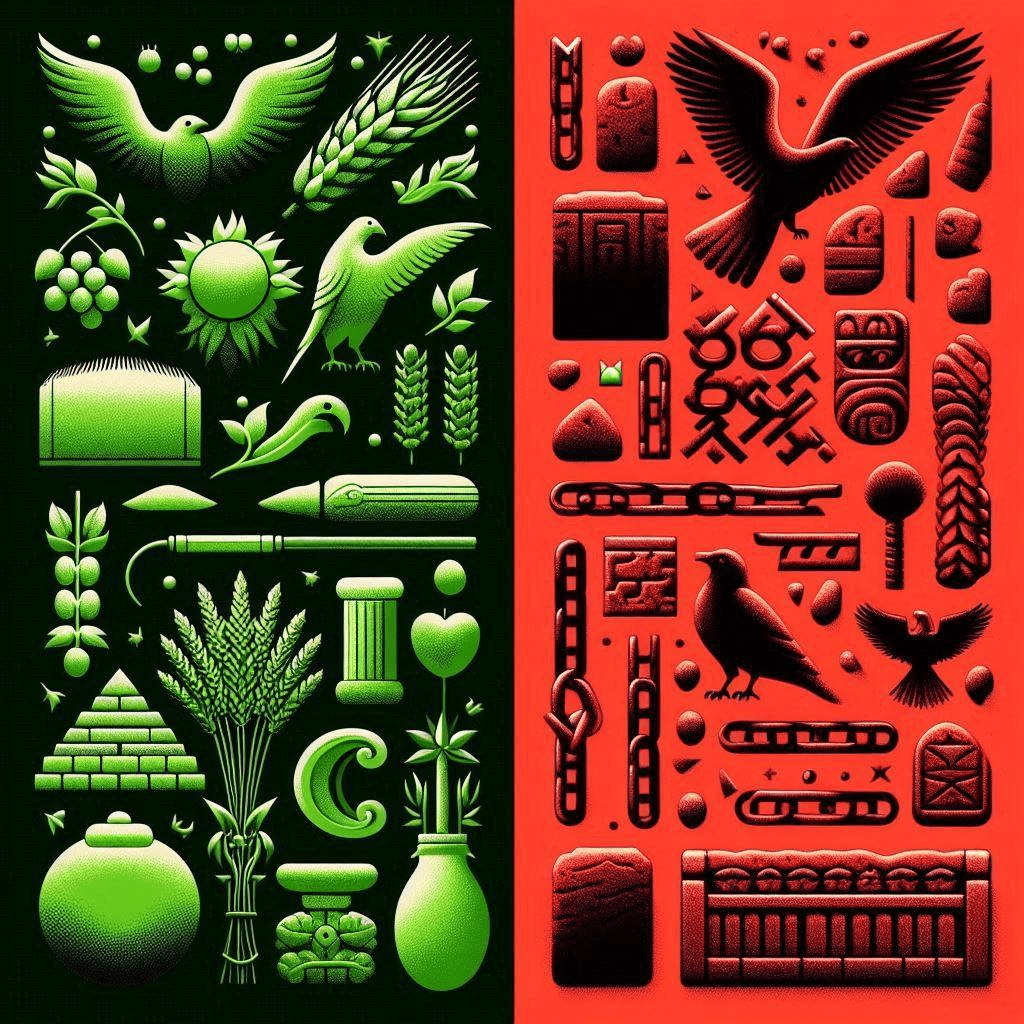
What is the “green” Gospel? This is a teaching close to the words of Jesus himself about the Kingdom of God within man, which is like a green plant. Jesus told a large number of parables on this topic. If this spiritual plant grows in the mind and heart of man, gives fruit, then this is actually the salvation of the soul. In contrast, there is the “red” Gospel. This is an interpretation of the life and teachings of Jesus, which emphasizes redemption, ransom through blood. The idea of redemption is undoubtedly very ancient: many religions use the concept of sacrifice in one way or another. In Christianity, the idea of the “red” Gospel originates in the Old Testament.
In Protestant exegesis, especially among the Reformers (e.g. Calvin), there is the idea that Cain’s sacrifice was rejected because of the spirit in which it was offered, but some went further and connected it with the curse of the ground and the lack of blood in Cain’s sacrifice, which brought fruits, vegetables, grains and other agricultural products to God. Abel offered animals as a sacrifice, supposedly a prototype of the future blood sacrifice (analogous to Christ’s), which is accepted by God. Cain offers a vegetable sacrifice “of the fruits of the ground” – supposedly unacceptable because: the ground was cursed by God after the Fall; his sacrifice did not contain blood, and “without the shedding of blood there is no forgiveness”; and finally, it was formal, not heartfelt. Therefore, Christ as the “Lamb of God” is a continuation of the “line of Abel”, whose blood sacrifice was pleasing to God.
Such a theory exists and is found in patristics, Protestant hermeneutics and typological theology. It symbolically connects Abel with Christ and his sacrifice, and Cain with a sterile religious formality. However, to be fair, it should be mentioned that not all confessions adhere to this theory. It does indeed have many weak points. The synthesis of Jesus’ teaching and the Old Testament on this basis is highly questionable.
First, all animals eat plants that were supposedly cursed. It is unclear how animals escaped the curse when nutrients from plants and other organic foods are absorbed directly into the bloodstream. However, the main problem with the blood-shedding theory is that Jesus’ teachings and some New Testament passages claim that the shedding of blood is not necessary for forgiveness. Here are some examples.
As is well known, John the Baptist preached “the baptism of repentance for the forgiveness of sins.” For hundreds of years, Jews believed that a sacrifice in the temple was needed for forgiveness, but John taught that a person must simply repent and stop doing evil. John’s water baptism meant the washing away of sins as a result of repentance. This bloodless understanding of forgiveness runs like a red thread throughout the New Testament. Let us recall the call “Repent therefore and turn to God, that your sins may be blotted out…,” or phrases such as “If we confess our sins, He is faithful and just to forgive us our sins and cleanse us from all unrighteousness,” or: “For godly sorrow produces repentance leading to salvation and a regretless return….” Although other texts, such as Romans or Ephesians, speak of forgiveness “through His blood,” that is, the “red” understanding of the Gospel, many New Testament episodes emphasize precisely the calm, peaceful “green” repentance and conversion as the necessary and sufficient conditions for forgiveness.
The most important words are undoubtedly those of Jesus himself. In the parable of the publican and the self-confident Pharisee in the temple, Jesus says the following about the publican’s prayer and its result: “God, be merciful to me, a sinner!” I tell you, this man went down to his house justified rather than…”. We see here only sincere repentance, subsequent justification and no blood. In another parable describing the Kingdom of God, Jesus paints the image of a sinner and a king who forgives a debtor all his debts in response to the request: “Then that servant fell down and bowed down to him, saying, “Sir, have patience with me, and I will pay you everything.” The lord, moved with compassion for that servant, let him go and forgave him the debt”. There are several other places from the authentic teaching of Christ and His life that say that one does not need to shed someone’s blood to have sins forgiven.
The text “without the shedding of blood there is no forgiveness” from the Epistle to the Hebrews speaks in favor of the theory of the “red” Gospel. There are such capacious theological statements that powerfully determine the course of thought of many generations. Paul, or the author of the Epistle to the Hebrews, expressed precisely such a short and maximally understandable idea. How to explain this, how to combine and synthesize the idea of the shedding of blood with the requirement only to repent in order to receive forgiveness? This difficult choice will have to be made only by those who believe that every letter of the Bible is the Word of God. From the point of view that only the personal words of Jesus are the flawless and infallible Word of God, the answer is simple: the phrase “without the shedding of blood there is no forgiveness” is simply the personal theology of the author of the Epistle to the Hebrews.
As the spiritual growth of believers in Jesus and the progress of civilization, there always occurs a kind of evolution: a departure from outdated theological forms in the direction of more perfect and more precise definitions of spiritual values. Accordingly, the shift from the “red” to the “green” Gospel is only a matter of time. If faith has always been the main secret of salvation at all times, then the need for sacrifices and blood can be explained simply by the fact that ancient man could not truly firmly believe in the forgiveness of sins until he saw the agony of an animal and the red stream of blood flowing from the altar. Every sacrifice of an innocent animal was actually intended for man, with his imperfect psychology, and not for God. Sacrifices fed the faith of the ancients. A more perfect understanding consists in a firm belief in the mercy of God, in faith in Him as a Father, in the possibility of forgiveness, in sonship and fellowship with Him. Without any bloodshed. This is what Jesus taught.
The teaching of Jesus says that the salvation of the soul is a matter of love and constant spiritual growth, and not a matter of redemption through bargaining. Why did Jesus die then? This question is asked again and again, not understanding how one can talk about salvation without blood. Jesus died for us. Man has difficulty believing until he sees the blood flowing from the altar. Jesus’ sacrifice was intended only for the imperfect psychology of man. This sacrifice feeds our faith. The sight of the crucifixion in our time still feeds our faith. Christ did it out of love for humanity. Jesus’ gospel of faith, love and spiritual growth is also intended for us. The “green” gospel is intended for the liberated consciousness that believes in the Heavenly Father without any rituals and sacrifices. The teaching of Jesus feeds our inner spiritual plant that reaches out to the light, to its Heavenly Father.














 Follow Jesus Christ
Leave a comment