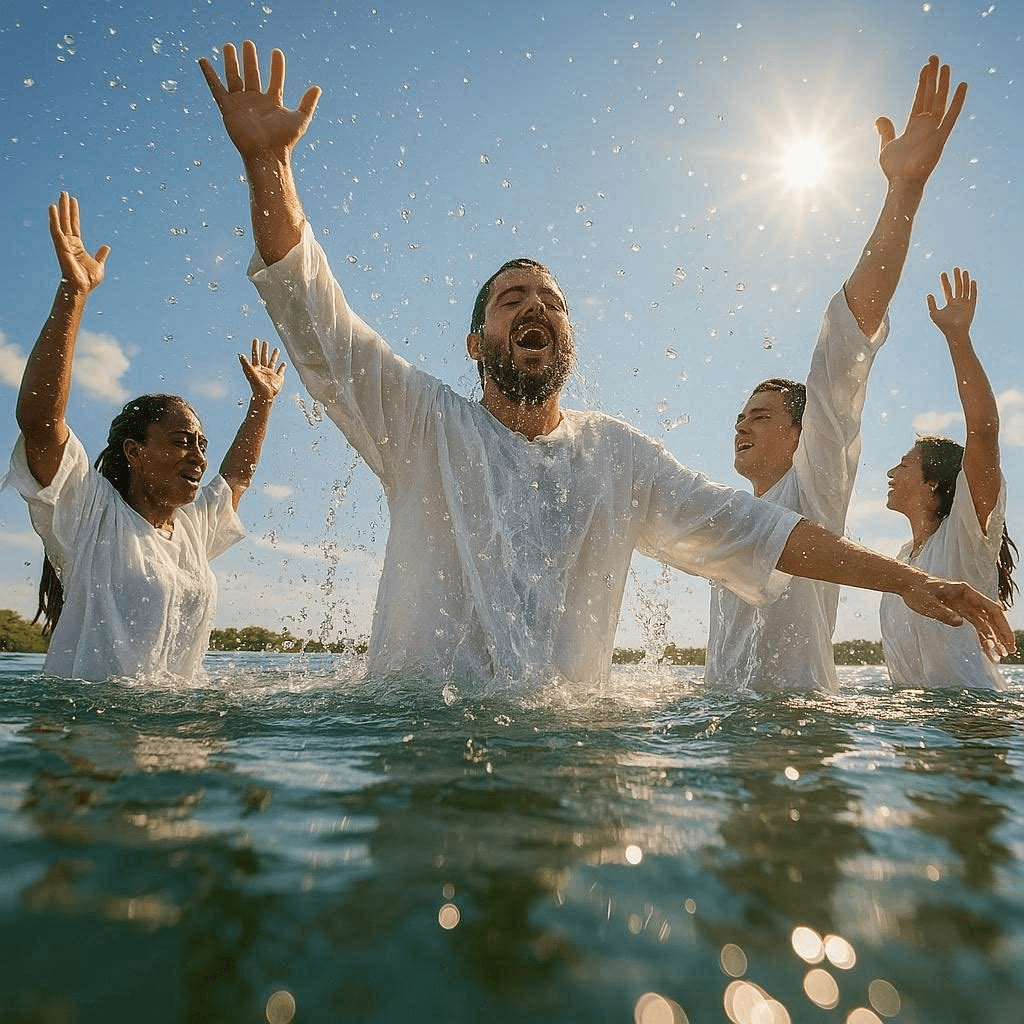
The sun was high, generously flooding the rocky banks of the Jordan with light. The river, slow and warm, flowed between willows and reeds. Bright reflections lay on the surface of the water – like silver birds that had settled down to rest. People stood on the shore with bare feet in the coastal mud, feeling how it softly envelops their feet. The hot breath of the desert still burned their backs, but a coolness blew from the river, and this breath seemed like a touch of mercy from above. They were preparing to take a religious ablution.
The rite of baptism, or washing with water, has a rich history. In the Old Testament and ancient Israeli tradition, ritual washings (mikvah) were prescribed by the Law of Moses before entering the Temple, after ritual impurity (for example, after touching a dead body, leprosy, etc.). This was not a symbol of rebirth, but purification for access to God in a cultic sense. The prophets had already begun to speak of spiritual purity, linking washing with internal repentance: “Wash, cleanse yourselves…”. The idea of internal renewal, and not just external purity, was already emerging.
In Hinduism, ablution is one of the oldest rituals, dating back to the Vedic religion (around 1500 BC). Its significance was both physical and spiritual purification (removal of “papa” – sin, filth). It was forbidden to make sacrifices, pray or touch sacred objects without ablution. Water was understood as a connection with divine energy (especially in the Ganges River), a force capable of washing away not only dirt, but also the karmic consequences of actions. Daily morning ablutions were often practiced, especially at dawn. In Buddhism, ablutions were performed by monks as part of their daily discipline in order to purify the mind and body before meditation or vows.
During the Second Temple Period, the Essenes and Qumranites also made ablutions a daily spiritual practice, expressing dedication to God and the community. When converting to Judaism, a pagan was immersed in water as a symbol of complete purification from the “pagan past.” The baptism of John the Baptist was no longer just a ritual of purity, but a prophetic act: a person acknowledged his sins, repented, and prepared for the coming of the Messiah. Christian baptism in the apostolic era after Pentecost was a sign of repentance, acceptance of Jesus as the Messiah, and inclusion in the Church. Apostle Paul, in addition to the purification from sins, added a new meaning to baptism: it became death and resurrection with Christ.
Beginning with the first centuries of Christianity, baptism entered a period of institutionalization. The catechumenate appeared – a long period of preparation, sometimes years. Baptism was usually performed on Easter or Pentecost. Immersion in water became threefold, in the name of the Father, Son and Holy Spirit. Anointing and laying on of hands (protoform of chrismation) were added to baptism. Baptism meant joining the Christian community and receiving salvation. In the Middle Ages, there was a transition to infant baptism. Gradually, almost all “new converts” became children born into Christian families.
The purpose of baptism became the need to save from “original sin.” For practical reasons, pouring was used instead of full immersion. During the Reformation in the sixteenth century, Lutherans and Calvinists retained infant baptism, but at the same time demanded conscious repentance and faith. Modern Christians see baptism more as a personal testimony of faith, a promise to God, or simply as a symbol of acceptance into the community.
What meaning did Jesus put into baptism? Having received water baptism from John, He obviously could not understand baptism as cleansing from sin, since the Son of God cannot sin. Jesus understood baptism individually, in His own way: as the beginning of public service, a vow before the Heavenly Father, and so on, depending on His spiritual need. The Evangelist John pointed out that Jesus did not teach water baptism, it was not part of His personal teaching. However, the apostles baptized. The understanding of water baptism by the apostles themselves can be found in the New Testament. However, this list of how the meaning of water baptism changed in the minds of people says one thing: the understanding of water washing is dynamic, unstable, secondary in relation to the spiritual teaching of Jesus.
What might the rite of baptism be from a Christocentric perspective, given the centrality of the person and teaching of Jesus? Here is a new understanding: baptism is not simply a washing away of sins, not merely a promise to God or joining a local congregation. It is more. It is a symbolic immersion in the ocean of the person of Christ. The water is His love and truth, into which we enter completely, leaving the old self on the shore. When we emerge from the water, or after being doused with water, we remain who we were, we do not die and are not resurrected. However, that moment will forever symbolize for us the cleansing abiding in Christ, the future full unity that will happen one day in eternity.













 Follow Jesus Christ
Leave a comment