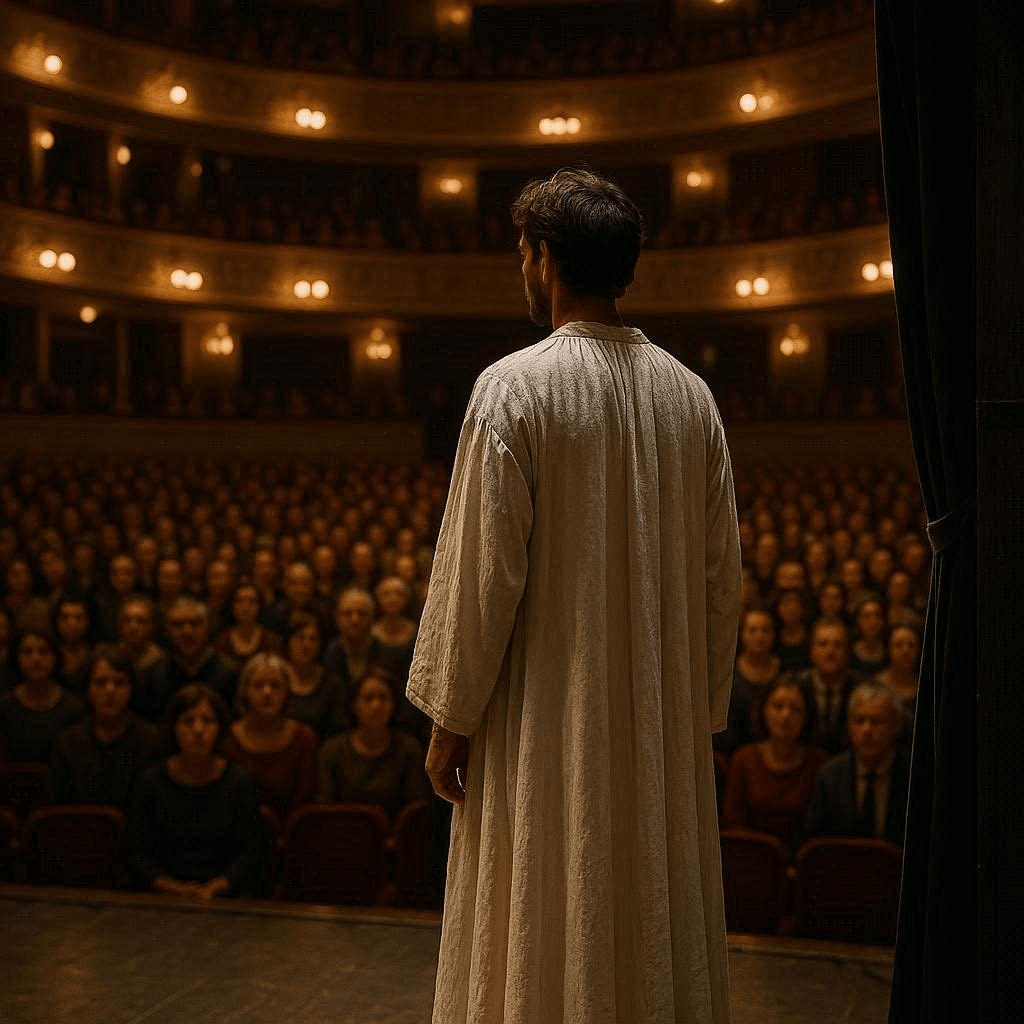
Here is an actor standing backstage. The dim light is filtering through the cracks in the curtain, the stage is breathing loudly with emptiness, the audience is waiting in the hall. He closes his eyes. He takes off – invisibly, but noticeably – the clothes of everyday worries, like an old, worn-out shirt. Just a moment ago he was himself, with his heartbeat, fears and memories. Now – inhale. And with this inhale, another life enters him. He feels how his posture changes: his shoulders rise, his step becomes confident, his voice grows stronger. His own habits, his vanity – disappear like dust shaken from a cloak. He is no longer acting, he is the one he must embody. He goes on stage. And the audience sees not an actor, but a new person.
Paul, from the height of his spiritual growth, several times mentions an idea like “Put on our Lord Jesus Christ.” What does this mean? What efforts are needed to achieve such an effect of “clothing,” entering into the image? Theatrical art is close in meaning and significance, of course with a number of reservations. According to Stanislavsky, an actor should not just play externally, but live internally – fully enter the role, think, feel and act as his character. Stanislavsky taught that art is believable when the actor “believes in the proposed circumstances” and through this becomes the character.
Apostle Paul may be speaking of a similar principle: to put on a new man does not mean to put on a mask or to follow external rules, but to internally accept a new nature. This is not a role for the public, but a new “personality from within.” The difference is that an actor always has a return — after the performance, he takes off the role and returns to himself. For Paul, the role of Christ and the new man is not taken off — it must become a permanent identity. And here there is a fear of losing one’s true personality, of not going back beyond the role according to Stanislavsky’s system.
The correct understanding of this issue is contained in the teaching of Jesus. Of course, it is right and necessary to look into the inner world of Christ and even try on the suit of His personality. By the way, Jesus’s suit and shoes will always be too big for us, and His role is unattainable in height and nobility. But the fact is that we cannot lose our personality, we cannot merge with someone to the point of losing our personality. And here the idea of gradual spiritual growth, which is beyond our control, comes to the fore, as Jesus repeatedly spoke about. I can enter the image of Jesus one way or another, and the more often I do this, the more perfect I become. However, I will inevitably leave His image and return to myself. The real transformation of my personality depends on time and God, and not only on my daily efforts. This is a spiritual mystery.
Unnoticed, without my participation, but in accordance with my highest desires, I will be given a new suit of clothes that will be very similar to the clothes of Jesus. They will be my clothes, organically expressing my inner world. And I, who have tried all my life to be like Jesus, will one day go on stage and play a new role: my own unique role, in which my individuality and the divine individuality will be intertwined. Perhaps it is this transformation that is called in the New Testament “receiving a new name,” that is, a new essence, a new version of my own “I,” on which both God and I have long labored.
Many actors have a difficulty: sometimes they do not understand their stage image or they do not like the role. They cannot make the role their own. The genius of all great actors is always that they can make any role their own, find common ground, feel everything that unites the actor and his character. In the spiritual theater, so to speak, the secret of genius is not so complicated. Transforming into the image of Christ, a person must understand that God is his Father, just as He is the Father of Jesus. In fact, our transformation is based not on art or methodology, but in our blood, its secret is in the very core of the soul. We are children of God, we are given a lot by nature. We are talented. The stage is waiting for us. We will succeed.













 Follow Jesus Christ
Leave a comment