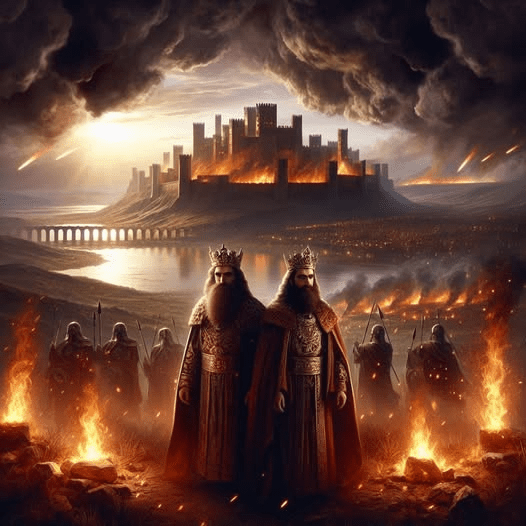
Chapter seven of the book of Isaiah is one of the most contested passages in the history of religion. It begins with the prophet’s challenge to King Ahaz: “Ask for a sign!” Ahaz refuses, and Isaiah utters the famous words: “Therefore the Lord himself will give you a sign: behold, the virgin shall conceive and bear a son, and shall call his name Immanuel.”
It is the word “virgin” that has become the sticking point. Christianity reads it literally, pointing to the birth of Jesus from the Virgin Mary. Judaism holds that the original Hebrew uses the word “almah,” meaning “young woman,” and understands the prophecy as referring to events in the eighth century BCE, when Jerusalem was threatened by two contemporary kings — Rezin (Aram/Syria) and Pekah (northern Israel).
But there is a striking detail that is rarely noticed: if you follow the logic of the prophecy rather than only its words, it unexpectedly echoes the biography of Jesus. “Before the child knows how to refuse the bad and choose the good… the land will be deserted by both its kings”: Isaiah speaks of an infant who will grow to childhood and live through the fall of two kings. Read in the light of the New Testament, a curious parallel emerges.
According to the Gospels, after Jesus’ birth his parents fled to Egypt — a tradition that links them with Jewish communities in Alexandria, one of the largest centers of the Diaspora. They remained hidden there until the death of Herod the Great (traditionally dated to 4 BCE). After Herod’s death, rule over Judea passed to his son Archelaus. The Roman emperor Augustus appointed him ethnarch, underscoring Judea’s dependence on Rome. Archelaus ruled roughly from 4 BCE to 6 CE.
Archelaus’ reign was brutal and unpopular. Josephus writes that he suppressed uprisings with bloodshed, and on one occasion about three thousand people died. Persistent complaints from Jews and Samaritans reached Rome, and Emperor Augustus removed Archelaus from power. In 6 CE he was sent into exile in Gaul, to the city of Vienne. After that, Judea was governed by Roman procurators — the era of Pontius Pilate.
So the infant Jesus literally lived through the fall of two rulers who threatened his family: first Herod the Great, then his son Archelaus. After the second ruler’s downfall the situation changed radically — authority passed directly to Rome. Yes, in Isaiah’s historical context the prophecy spoke of different kings. But the figurative sense — a child who survives the removal of two rulers — unexpectedly resonates with the Gospel story.
Biblical prophets rarely spoke as if giving a straightforward historical timetable of “where, when, and who.” Their language is imagistic, multilayered metaphor, condensed meanings. A single prophecy can have a literal sense (in the context of the eighth century BCE), a symbolic or typological sense (in relation to the life of Jesus), and a spiritual interpretation (for believers in various eras).
This is a feature of the ancient Hebrew tradition: events repeat, rhyme with one another, and are actualized in new circumstances. For Judaism Isaiah is speaking about the immediate political threat. For Christianity he speaks of a distant future and the birth of the Savior. Both readings can be held at once, and that is one of the Bible’s strengths: it lives on several levels of meaning.
If we set aside the familiar quarrel over the word “virgin” and look at the image as a whole, we see a prophecy about a child who outlives two rulers and a subsequent change in the fate of the people. That is precisely what happened with Jesus: he was born in the time of Herod, returned from Egypt after Archelaus’s fall, and Christians associate his name with Immanuel — “God with us.” Prophets did not see only their own time — they saw patterns in history that become intelligible centuries later.
Interestingly, Jesus himself treated prophecy in this multilayered way. His words, “I did not come to abolish the law or the prophets, but to fulfill them,” are often understood as mere observance of ancient commandments. But the Greek word translated “fulfill” (plerōsai) does not mean simply “to carry out formally”; it means to fill with meaning, to reveal depth, to bring to fullness. Jesus did not annul the old texts — he revealed in them hidden levels that had previously been unseen. That is why Isaiah’s prophecies can be read not only in terms of the literal circumstances of Ahaz or the debate over the translation of “almah,” but also in the light of the historical journey of the infant Jesus, who lived through the fall of two kings. In this approach a prophecy is not confined to one century or one event — it acquires a long life, reverberates from age to age, and manifests itself in different layers of history.











 Follow Jesus Christ
Leave a comment