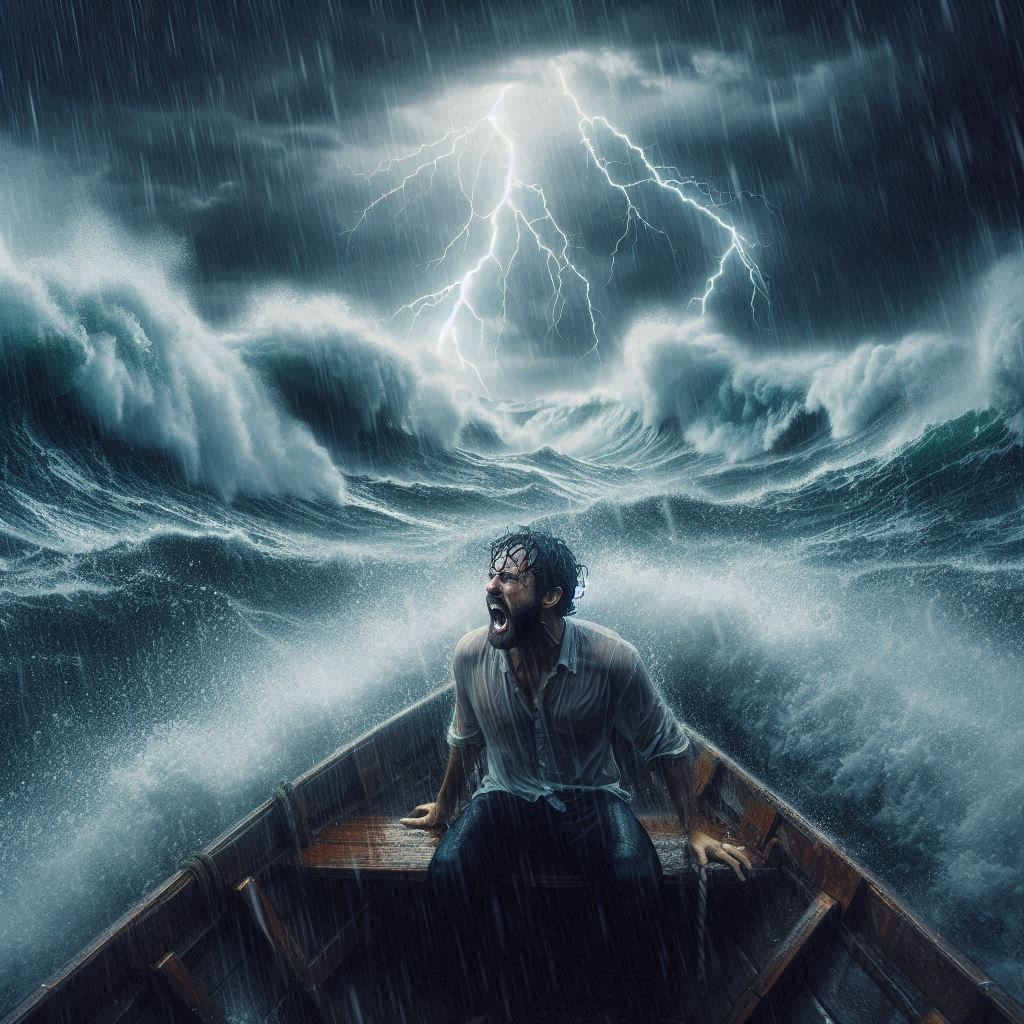
When the wind rises, a person may at first think it’s only temporary. Then the roar grows, the trees begin to bend, the sky and the water darken, and the boat starts to be tossed from side to side. In such moments it becomes clear: it doesn’t matter how prettily the boat was painted or what its name is. What matters is whether its hull will hold. What matters is whether the people in the boat will hold together.
Picture a fishing boat on the Sea of Galilee. In calm weather it glides easily over the water. The fisherman feels confident. But when a storm suddenly blows up, everything changes. The boat is tested not by words but by the water itself. It is in sailing and in storms that you see how sound its planks are, how deeply it sits in the water, how well it’s built.
Philosophy has long reflected on why life needs such “storms” at all. Aristotle would say that virtue isn’t formed without effort. Courage is impossible without danger. Patience cannot exist without pain. Remove risk and maturity disappears. A world without storms would not produce strong characters but infantilism.
The Stoics would add: the storm is an external factor. But the inner stance remains free. The wave does not determine who you will become; it only reveals who you already are. The boat may creak and yet hold. Or it may develop a crack. The existentialists went further: crisis shatters illusions. While the sea is calm a person lives on autopilot. When the storm comes, he is forced to ask the fundamental question: what is my life founded on? The storm brings to the surface the deep foundations of the self.
Contemporary psychology speaks of post-traumatic growth. Some people, after severe crises, become deeper, more resilient, and clearer about their priorities. The storm does not guarantee growth, but it creates the space for it. A boat that has survived a storm is no longer the same as before.
These philosophical perspectives fit remarkably well with the authentic teaching of Jesus. Jesus adds the dimension of the soul’s salvation. In his words, salvation is not simply an instantaneous change but a path. He speaks of the Kingdom as a seed that grows, of the vine and its branches, of fruits, of a new heart. This is dynamics. This is a process.
If salvation is growth, then the storm ceases to be a mere accident. It becomes a testing point for direction, an environment for ongoing change. The boat is not rescued from storms forever; it learns to go through them. The person who follows Christ does not avoid crises, but his center is strengthened in them. In calm weather it’s easy to talk about faith. In a storm faith becomes a real support.
Jesus does not romanticize suffering. He does not call people to seek storms for their own sake. But he speaks of the house built on a rock. The difference between houses becomes apparent precisely when wind and water come. If the foundation is deep, built on rock, the house stands. If not — it collapses.
Here a tension arises with a popular Christian emphasis on “status.” Many claim that at the moment of the cross a legal change occurred: a person received a new standing before God. But if one focuses only on status, one can miss the heart of the matter. A boat may receive an official “seaworthy” certificate, but that does not mean it will withstand a storm. Jesus’ teaching about growth shows that salvation is not only a declaration but a becoming. If a person is declared righteous but does not change inwardly, the storm will nevertheless expose the weakness of the structure. Status without transformation will not hold back the wave.
This is not to deny the cross. The cross can be understood as the revelation of the Father’s love, as the breaking of fear, as the restoration of trust. But if it is regarded only as a legal act that changes an entry in a heavenly ledger, there is a danger of formality. God is not changed by a procedure; he does not need to put on rose-colored glasses that make a person look better. The person changes — if they allow themselves to grow.
We can distinguish three levels: origin, relationships, and consciousness. A person’s origin is beyond doubt: a person is created by God, is a child of God; here no new status is required. The problem lies elsewhere: relationships may be broken, consciousness may be closed. Life’s storms operate precisely on the levels of consciousness and relationships. They lead a person to acknowledge their sonship — if, of course, the person does not resist.
When a boat goes through a storm, it either becomes stronger or it falls apart. After a storm people may repair or modify boats, reinforce the structure. Salvation in Jesus’ teaching is like the gradual strengthening of the hull. It is a movement toward inner wholeness, toward trust in the Father, toward freedom from the secondary. The storm narrows the focus to what matters most.
A world without trials would be a world without depth. But a world of nothing but storms would be unbearable. Life is an alternation of calm and wind. In the calm one builds. In the storm one is tested. And if following Christ becomes the center of one’s life, then every storm weathered makes the foundation firmer. In the end the question is not whether a person has status but whether their boat will withstand a real wave — what their true essence is. Salvation is not escape from the sea but the ability to go through it, growing stronger with every storm survived.










 Follow Jesus Christ
Leave a comment