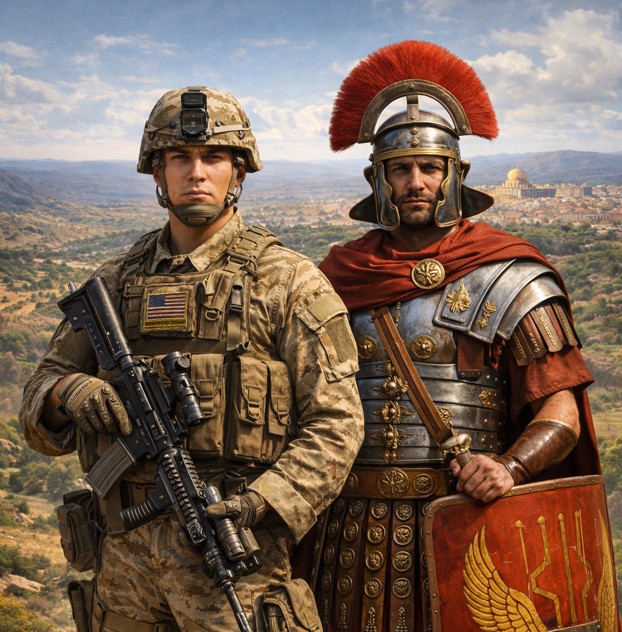
Many contemporary evangelicals believe that a war in the Middle East must occur for Christ to return. That creates a serious moral dilemma when believers support real wars in the region and forget their Teacher’s command to overcome evil with good. It’s a very interesting and complex topic. American evangelicals link Middle Eastern wars to Armageddon because their theology (dispensationalism) requires a literal fulfillment of prophecy. The creation of Israel is seen as a key sign, popular books and films have cemented this model, and finally U.S. political culture reinforces the view. So every new event in the region is automatically treated as a possible “prophetic moment.”
Most Christian traditions hold that biblical prophecies are symbolic and cannot be directly tied to contemporary politics. This is the standard view in Catholic theology, in Orthodoxy, and among most academic Protestants. So why do American evangelicals react so intensely to every war in the Middle East? For them it means the Bible “is coming to life before our eyes”; it’s a source of inspiration—though, tragically, one for which the peoples of the Middle East often pay dearly. Support for Israel in America has become a religious duty; many believe that blessing Israel equals blessing America. As we can see, this affects U.S. foreign policy.
The reasons why American evangelicals often connect events in the Middle East with Armageddon lie in a combination of theology, U.S. history, and twentieth-century politics. The main cause of these views is dispensationalism. Dispensationalism is a scheme for interpreting the Bible according to which history is divided into stages (“dispensations”). Israel and the church are two separate plans of God. Before the end of the world there is supposed to be a restoration of Israel, a war in the Middle East, Armageddon, and finally Christ’s second coming. When did this theory arise? In the nineteenth century. Its founder was John Nelson Darby. Darby developed the idea of the rapture (the church’s being taken up) and the literal fulfillment of the prophecies concerning Israel.
In 1909 the Scofield Reference Bible was published. It’s an ordinary Bible with commentary, but the notes explained prophecy through the lens of dispensationalism, linking ancient texts to contemporary geopolitics. This Bible became extraordinarily popular among American Protestants. It effectively shaped the thinking of millions of believers. They read those notes and compared them with events in the Middle East. That was probably a highly vivid exercise of the imagination. Many evangelicals took the creation of the state of Israel as a literal fulfillment of prophecy. In their scheme the restoration of Israel triggers the end-time events. So any conflict around Israel, any war in the Middle East, was seen as part of a prophetic chain.
In the 1970s the bestseller The Late Great Planet Earth appeared, written by Hal Lindsey. He claimed the USSR was the Gog of Ezekiel’s prophecy, with the Arab states as its allies. He argued that war in the Middle East was inevitable. The book became one of the best-selling titles in the world. The USSR never became Gog—indeed it disappeared from the map. In the 1990s the Left Behind series by Tim LaHaye and Jerry B. Jenkins enjoyed enormous success. Those novels depicted the rapture, world war, Armageddon, and the Antichrist. More than 80 million copies were sold. For many believers this fictional framework became almost a literal picture of the future.
And just recently, in 2026, several U.S. evangelical leaders declared that events in Iran—U.S. and Israeli strikes, the death of the supreme leader, and regime instability—might be the fulfillment of biblical end-times prophecies: another, so to speak, final stage of the last phase before the end of the world. Conservative Christian outlets like Salem Media Group spread these views. Iran is usually presented as a source of evil, military actions are described almost as instruments of God’s plan, and a “revolution” and mass conversions to Christianity are expected. This has become typical rhetoric in evangelical political media. Believers, as always, mobilize in the face of the end times; these views give events special meaning, reduce anxiety, and create a sense of living in a unique era.
However, despite dispensational theory, there are real grounds for concern—first and foremost the suffering of people in the Middle East. Comfortable Americans only know what falling bombs are from television. Christians claim that these sufferings are “part of God’s plan,” that suffering can lead people to God, that God judges evil. But why should God judge evil only in the Middle East? Why would God supposedly need violence and war to fulfill prophecy? Where is the support for these theories in the authentic teaching of Jesus? Did Jesus himself achieve his goals by means of war or not? Why does a tension arise between the ethics of Jesus and apocalyptic expectations?
Jesus actually taught that the Kingdom of God comes through mercy, forgiveness, and change of heart—not through catastrophes. No war or disaster achieves the primary goal of spiritual rebirth and human transformation. Christianity points toward the unavoidable conclusion that the apocalyptic expectations of early Christians were not the central component of Jesus’ teaching. Jesus taught that God’s Kingdom is more of a spiritual reality: it begins within the individual, spreads gradually, and is tied to humanity’s spiritual evolution. In other words, history is not moving toward catastrophe but toward slow spiritual development—a kind of spiritual springtime for humanity. Thus all wars, however they are justified, are the result of human mistakes and vices, and they were never God’s plan.













 Follow Jesus Christ
Leave a comment