Life fairly quickly strips a person of illusions. It shows a simple truth: everyone sins. Christians are no exception. Often this is realized with some embarrassment, and then the familiar formula is heard: everything is covered by “the blood of Jesus,” everything is forgiven by Golgotha — you only need to repent. But if you look honestly at reality, it becomes clear that the salvation of the soul cannot be reduced to mere external justification. It is connected to something deeper. It involves an inner change in the person. Salvation depends on the power of personal repentance and the depth of spiritual growth. Not on speed, but on quality. This, essentially, is what Jesus’ teaching is about. At the same time, spiritual growth is not the result of human effort alone — it happens thanks to a mysterious spiritual power that works within a person and gradually restructures their life.
In practice this growth is rarely smooth and straight. It is more like a spiral. A person moves forward, then slips back, then rises again. Habits retreat, but sometimes return. There are periods of clarity and inspiration, and there are times of fatigue and stagnation. A genuine transformation is usually accompanied by a weakening of the coarse forms of sin. But here a paradox appears. First the obvious, crude manifestations disappear — blunt lying, crude cruelty, blatant injustice. Yet then the person begins to notice more subtle things: pride, irritability, hidden vanity, an inner coldness. Objectively the person is becoming better, but subjectively they may feel worse, because their awareness becomes more acute.
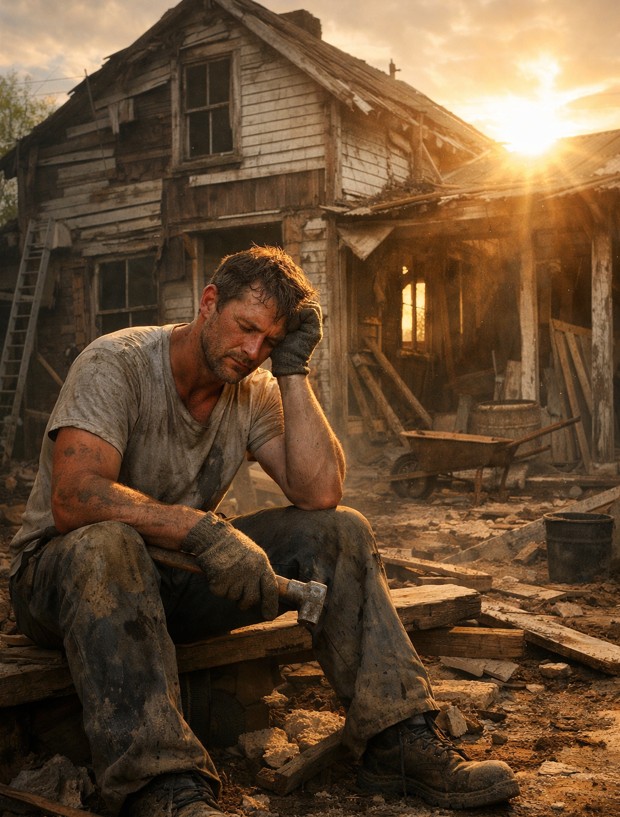
This process is much like renovating an old house. When a house stands closed and untouched, everything seems quite decent. But once you begin to renovate, you discover cracks in the walls, rotten beams, warped floors. Sometimes the house looks worse during the renovation than it did before: the old paint is stripped away, walls are taken apart, there is dust and construction debris everywhere. But what is happening is not destruction but restoration. The house gradually becomes stronger and more secure.
A similar thing happens when you clean out an old well. At first the water seems fairly clean. But as soon as you start pulling out the silt and muck from the bottom, the water clouds. Buckets lift the dirt, and for a time the water becomes almost opaque. Only after a while does it begin to clear and truly become clean. The same happens with the human heart: when its cleansing begins, what had lain at the bottom rises to the surface.
Sometimes spiritual growth is like tuning a musical instrument. The instrument may sound out of tune, but over time the musician tightens the strings, adjusts the tension, searches for the right pitch. Sometimes a string must be tightened, sometimes loosened. If you handle it clumsily, a string can even break. But patient tuning gradually leads to harmony. In the same way the human soul is gradually tuned to a purer sound.
That is why spiritual growth is often painful. It means an internal restructuring of consciousness. Old habits resist, old reactions return, and the person experiences an inner struggle. In this sense salvation is not only joy but also labor. It is a process in which a person gradually learns to live differently. Christianity is not a status or mere group membership. It is a path — a path of inner transformation, where the chief practical benchmark becomes the capacity to love others.
Over time, often through inner suffering, a person begins to change. They become gentler. They judge others less because they better understand their own weakness. They grow in humility. At the same time they become freer from the passions and desires that usually govern human life — from the thirst for recognition, from the drive for superiority, from the constant inner struggle for one’s place. And paradoxically, the spiritually growing person becomes increasingly aware of how far there still is to go. Their inner sense is more likely to say, “I am only at the beginning.”
From this perspective the most dangerous sin is not human weakness. The most dangerous sin is spiritual closedness. It is the state in which a person stops changing — when they no longer repent, when they justify themselves by a system, when they convince themselves of their own righteousness no matter what. In the Gospels one can notice a striking thing: Jesus was especially harsh with religious people who had perfected the art of self-justification. At the same time he was remarkably gentle with those who were far from religion but did not possess that art of hypocrisy.
Because the path of salvation does not begin with confidence in one’s own rightness. It begins with a willingness to change. And that path continues throughout life.













 Follow Jesus Christ
Leave a comment