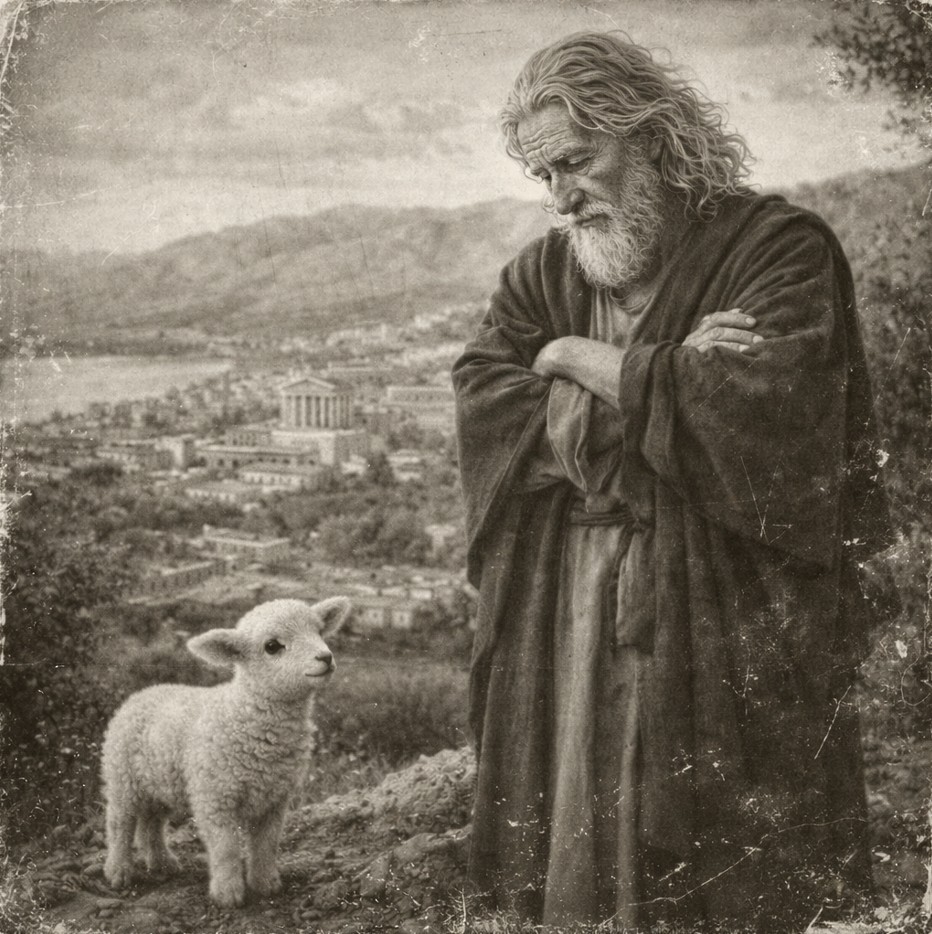
There is a striking detail in John’s account of the crucifixion: Jesus’ legs are not broken. At first glance this looks like a random historical minor detail, but in John’s text it carries powerful symbolic meaning. John insists that Jesus is literally the Passover Lamb.
At the end of the crucifixion narrative we are told that the Roman soldiers came to hasten the deaths of those crucified. Ordinarily they would break the prisoners’ legs so they would suffocate more quickly. But with Jesus it is different: “When they came to Jesus and found that he was already dead, they did not break his legs.” John immediately explains: “This was to fulfill the Scripture: ‘Not one of his bones shall be broken.’” Where does that quote come from? It is an obvious reference to the rules for the Passover sacrifice: Exodus 12:46, which says of the Passover lamb, “Do not break any of its bones.” In other words the lamb eaten at Passover was to remain whole.
John deliberately emphasizes that Jesus dies at the very time the Passover lambs are being slaughtered in the Temple — and that, like the Passover lamb, none of his bones are broken. It is almost the author’s literary signature: Jesus is the true Passover Lamb. But don’t rush to conclude a juridical “ransom” theory. The Passover lamb is not a substitute for a criminal; it is not punished for others’ sins, nor is it a payment for sinfulness. It is concerned only with liberation from slavery. In Exodus the lamb’s blood is the sign of salvation and the exit from Egypt. Thus John’s meaning is: Jesus is the one through whom a new Exodus — the liberation of humanity — occurs. John is not thinking in terms of a juridical theory of atonement.
From a legal point of view the idea of vicarious punishment is problematic. In every developed legal system the rule is: only the guilty are punished. For example, you cannot imprison one person for another’s crime; you cannot execute an innocent person in place of a criminal. Such an act in modern jurisprudence would be seen as a gross violation of justice. Even voluntary substitution is impossible. The law cannot accept: “I’m ready to go to prison instead of him.” A court cannot accept such a sacrifice, because the purpose of justice is to connect the offense with responsibility. So, in legal terms, the idea of literal substitutionary punishment looks like an anti-legal mechanism.
If you take the sacrifice literally in legal terms, serious problems arise: the principle of responsibility is violated and the innocent are unjustly punished. But if you understand it existentially or symbolically, the idea takes on a different meaning: the innocent, voluntarily accepting suffering, can change people’s hearts and break the cycle of violence. In John’s understanding the Passover lamb is not a savior in the juridical sense of paying for all sins. Figuratively, he is like a lit candle in utter darkness, or like a ticket for the last train out of a war-torn region. A passenger who boards that train may carry all his sins with him, but with the idea that he can turn away from a sinful life: he has been given a unique chance.
An interesting picture emerges. John almost never spells out a theory of salvation. He paints a symbolic scene: Jesus dies at Passover, his bones are not broken, he is called the Lamb of God. The reader is meant to see the parallel. John has another hidden parallel, too, where Jesus is connected not only with the Passover lamb but also with the scapegoat of Leviticus. That deepens the sacrificial image. Symbolically, the scene in which Barabbas is released while Jesus is killed resembles the ritual in which a scapegoat bears the nation’s sins and another animal is sacrificed. Barabbas goes free (like the goat carrying away sins), while the innocent Jesus goes to death.
Jesus himself criticized the cult of sacrifice. He denied the necessity of ritual sacrifices and quoted the prophet: “I desire mercy, not sacrifice.” For him inner change mattered more than ritual compensation. Therefore his death in early Christian consciousness was not understood merely as a sacrifice or a payment, but as an act of self-giving love. The lamb in early Christianity is not simply the one who “pays the debt.” It is the image of a person who does not answer violence with violence, who accepts suffering and thereby breaks the cycle of evil. The lamb-image John introduced became one of the most powerful motifs in Christianity: it shows a power at work through sacrificial love rather than coercion. And that image also communicated something real about Jesus: it made him more intelligible to people. Although, of course, the person of Jesus is far greater than the lamb-image, which necessarily omits many traits of Jesus. Modern generations often misunderstand the lamb symbol and tend to prefer more “aggressive” symbols, like the lion.
Everything you’ve just read about the lamb is John the apostle’s interpretation — his personal understanding of what happened. Jesus did not offer personal explanations of these matters, phrases like “not one of his bones shall be broken.” How much right did John have to interpret things this way? Where do Jesus’ own words end and the theological reflection of his disciples begin? Most historians and biblical scholars agree: the Gospel of John contains a theological interpretation of Jesus’ life, not merely a direct transcript of his words. At the end of the book John makes a remarkably candid admission: “Jesus did many other things… If every one of them were written down, I suppose that the whole world would not have room for the books that would be written.” This is effectively an admission: we have a selective and interpreted account.
Why did the disciples begin to interpret? After the crucifixion they faced a huge problem: their teacher had been executed as a criminal by Roman authority. For ancient Jewish thought this looked like catastrophe. They had to make sense of how the death of the Messiah could mean anything. So they began to reread Scripture and look for images: the lamb, the suffering righteous one, Passover, sacrifice. This is a normal process of religious thought. In every tradition something similar happens: first there is an event, then an interpretation of the event. For example: Buddha — Buddhist philosophy; Socrates — Platonic system; and finally Jesus — the theology of the apostles. The disciples were trying to understand the meaning of their experience. In Christian terms this process is often explained as the work of the Holy Spirit, and the apostolic legacy is frequently placed on the same level as Jesus’ own teaching.
Did the apostles have a “right” to interpret? Historically — yes. The apostles were participants in the early movement, witnesses to the tradition, members of the community reflecting on the meaning of Jesus’ life. Theologically, Christianity holds that this process was divinely inspired. But historically it remains an interpretation. Paradoxically, this may have been Jesus’ intention: to give his followers theological freedom to interpret his life and teaching in the terms and concepts of their time.
Jesus seldom gave theoretical explanations. In the Synoptic Gospels he almost never lays out his death as a detailed theory of salvation. He speaks in images: a grain falling into the ground, a shepherd giving his life for the sheep, a cup of suffering, a new covenant. For example: “Unless a grain of wheat falls into the earth and dies, it remains alone…” — a poetic image, not a juridical or theological formula. Many mistakenly interpret this as if Jesus failed to explain the theology of salvation in detail and left the task to the more educated Paul. But narrow theological narratives could not have inspired millions of followers. It was precisely the poetic, mysterious images that carried that energy and still inspire us today.
John probably grasped this point very well. He offers the reader lamb-images not only in his Gospel but also in Revelation, where the Lamb is a central figure and is mentioned some thirty times. In Revelation the Lamb undergoes an astonishing transformation: he is simultaneously sacrifice, king, and judge of the world — weakness and power joined. Interestingly, in Revelation the Lamb is almost never called “Christ” or “Jesus,” as if the author deliberately wants the reader to see the symbol continually, not merely the historical figure. This is a rather unusual literary move. It is one of the most unusual symbols in the whole Bible — and it was created by the apostle John, a disciple of Jesus Christ. And who knows — might John’s interpretation be closer to the truth than the theological and systematic interpretation of the apostle Paul?















 Follow Jesus Christ
Leave a comment