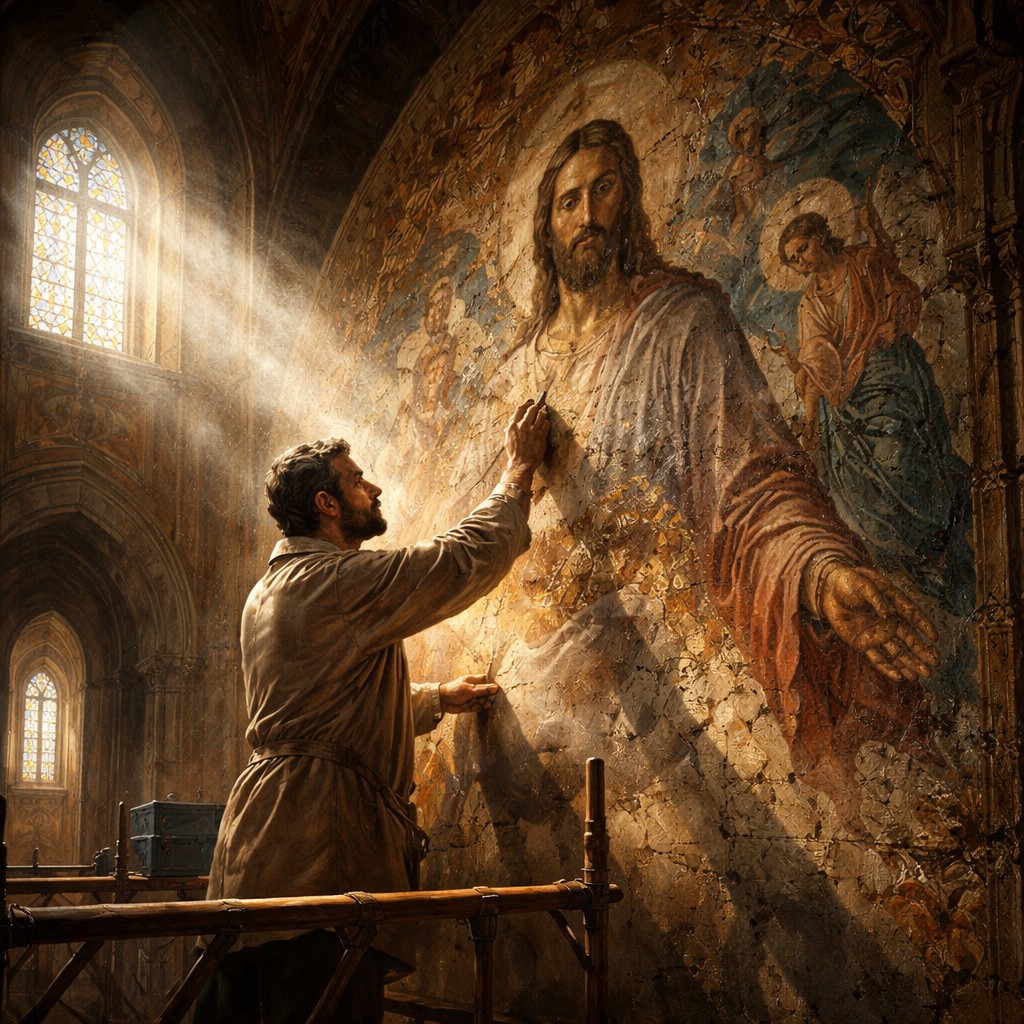
An old fresco almost never reveals itself at first glance. At first we only see a darkened wall, cracks, soot stains, later layers of paint, and in places clumsy retouching. To someone looking superficially it may seem that the original image is already lost. But a restorer thinks differently. He knows that later accretions do not cancel out the original. On the contrary: it is precisely beneath them that the original is hidden. You cannot simply invent it anew, but neither should you accept every later layer as the final truth. You need to remove the excess carefully, compare pigments, look for lines, peer into the details. It is slow work that requires both trust and sobriety.
I think the question about Jesus is more or less like that. A conservative Christian might say: “How do we even know about Jesus? If everything written by people is merely interpretation, then the Gospels are interpretations too. Jesus himself didn’t write a single book. We know about his words, life, and commandments only through Matthew, Mark, Luke, and John. Therefore, if we don’t trust the apostles as divinely inspired authors, we have no access to the real Jesus. Then everyone starts creating their own ‘Jesus,’ filtering out from Scripture whatever they don’t like.” At first glance this sounds very convincing, but the very way the question is posed already contains a flaw.
The argument is set up as if there are only two options: either the texts are fully divinely inspired in a literal, error-free sense, or we slide into total spiritual arbitrariness. But those are not the only options. Between absolute inerrancy and chaos there is middle ground, and it is precisely there that Christian thought has historically lived. One can consider the texts deeply trustworthy without declaring them to be a mechanical dictation. One can acknowledge their divine inspiration while also acknowledging living human understanding. One can see them as testimony rather than as a word-for-word transcript. One can say they are interpretation, but not arbitrary fantasy. In fact, that was often how Christians thought before the era of late fundamentalism. Even many Church Fathers did not speak in terms of the modern idea that every detail is literally without error.
Moreover, the Gospels themselves are already interpretations. This is not an attack on Scripture, but a simple fact. They were written after the events, by different authors, for different communities, with different emphases. Sometimes details differ: genealogies, the order of episodes, the words on the cross, the composition of the narrative. But from that it does not follow that we are facing mere whim. Here it is useful to recall archaeology. An archaeologist does not unearth a finished palace whole. He finds fragments of columns, broken tiles, remains of walls, shattered pottery, half-erased inscriptions. These fragments do not match in form and sometimes even seem contradictory, but it is precisely from them that the picture of the city is gradually assembled. The mismatch of individual details does not negate the reality of the city. It only shows that what has come down to us is testimony, not antiquity itself in pure form.
The same applies to the textual criticism of old manuscripts. Imagine an ancient text that has been copied many times. One scribe omitted a word, another rearranged a line, a third tried to explain something in the margin. If you look at this too crudely you might say: “Because there are differences, nothing can be known for certain.” But the opposite is true. The more copies we have, the easier it is to reconstruct the original core of the text. Differences do not destroy authenticity; they help us see it more clearly. That is how the Gospels work. They are not identical photocopies, but precisely because we have several voices before us, we can distinguish a stable core: the Kingdom of God, parables, love for enemies, mercy above ritual, inward purity, the call to personal renewal. This is not a random collection of phrases. It is a recognizable voice.
There is another image: music without an original recording. Imagine a great teacher left us no studio recording, but his students kept the notes, hummed the melody, and passed it on to different communities. Over time different performances appear. Somewhere the tempo is a bit slower, somewhere the accent stronger, somewhere an added local intonation. Yet the melody is still recognizable. It has not vanished simply because it was not preserved in pristine acoustic purity. On the contrary, it is precisely through different performances that its enduring core can be grasped. So it is with Jesus: we do not have his own book, but we have a living memory of him that has passed through witnesses.
At the same time the conservative position cannot escape interpretation no matter how much it strives for it. Even the strictest reader of Scripture still chooses what to take literally and what to take figuratively; what pertains to first-century culture and what pertains to all times; where the matter concerns a temporary discipline and where it concerns an eternal principle. In other words, no one reads the text without interpretation. The very contrast “either divinely inspired inerrancy or arbitrariness” is itself an interpretation—one possible but not the only one. And here the argument against the “made-up Jesus” partly returns to its speaker: every interpreter runs the risk of substituting the living Jesus with his own scheme, including the conservative interpreter.
Of course this does not mean one may discard the apostolic testimony with impunity and invent a Jesus to suit oneself. That path does exist, and history knows its forms—from ancient Gnosticism to the contemporary “Jesus who agrees with me about everything.” Balance is necessary. Nobody is suggesting we abandon the apostolic inheritance. On the contrary, it is precisely to that inheritance we must return again and again—but not as a smooth dictation, and not as something that fell from heaven outside of history and language. The genuine teaching of Jesus has not disappeared. It was not concocted by later authors out of whole cloth. Yes, it reached us through human words, through the memory of disciples, through their theological reflection, through differing emphases and forms of retelling. But it is precisely in that retelling of Jesus’ sayings that it has been preserved best. Not in the void, not in a dogmatic scheme, not in the fantasies of the modern reader, but in the tense field of early Christian testimony.
So the task is not to choose between blind literalism and freewheeling license. The task is something else: to seek, to restore, to conserve. Read the Gospels the way a restorer looks at a fresco, an archaeologist reconstructs a city from shards, a textual critic restores an ancient manuscript, a musician recognizes an authentic melody through different performances. This approach requires humility, because we do not possess Jesus completely. It also requires courage, because the true image cannot simply be replaced by a convenient scheme.
We are not creating Jesus anew. We have no right to do that. But we are not obliged to pretend that before us is a dictation dropped from heaven outside of history and language. The authentic teaching of Jesus has not vanished. It is not hidden very deep. It shines through the Gospels, through recurring themes, through inner coherence, and through the force with which these words continue to judge, console, and transform people. It truly needs to be sought. Sometimes—cleansed of later layers. Sometimes—assembled from fragments. Sometimes—relearned. But that is what a serious attitude toward the apostolic inheritance means: neither turning it into an idol nor scattering it to pieces, but carefully restoring the living face of the Teacher, who is still discernible beneath the layers of time.













 Follow Jesus Christ
Leave a comment