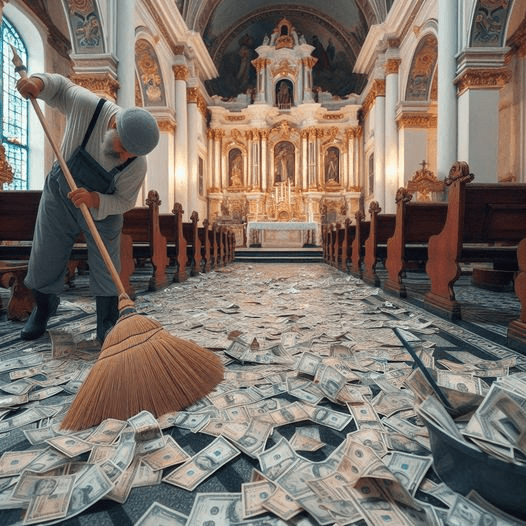
During the time of Jesus and until the destruction of the Temple, religious commerce flourished around the Temple rituals and ceremonies. The trade in animals suitable for sacrifice was a lucrative business. Believers were allowed to bring their own animals to the Temple, but often their animals were rejected and forced to buy animals from the Temple.
Part of this income was sent to the temple treasury, part of the money settled in the hands of the clans of high priests. Also in the courtyards of the temple were
numerous cash exchanges – the temple tax had to be paid only in Jewish coins. Temple pilgrims from all over the world were charged large interest rates on holidays. Incredibly large sums of money accumulated in the temple treasury when most people were living in poverty. Many ordinary people were outraged by all this commerce.
One day Jesus was trying to teach people, but there was a lot of noise around Him – an argument broke out at the money changer’s table, a herd of animals was being driven past, people were shouting and bargaining as if at a market. Suddenly, to the amazement of the entire huge crowd, Jesus took a whip and began to drive the animals out of the temple. The common people supported Him – the money changers’ tables began to be overturned, all the stalls were opened, all the traders and animals were driven out.
Returning to the platform to preach, Jesus said, “My house will be a house of prayer for all nations, but you have made it a den of thieves.” People understood that worshiping God should not be a source of income for some and ruin for others. This is unfair. Jesus repeatedly pointed out that lovers of money cannot be saved. One can imagine how Jesus felt about various swindlers and businessmen who covered up their despicable thirst for profit with religion.
Well, Jesus used national unity and physical force that day to protect the believers from the tyranny of corrupt religious authorities. Accordingly, according to Jesus’s action, physical force can be used against oppression, shamelessness and corruption of the authorities. The Gospel story does not mention that anyone suffered as a result of such a “revolution” in the temple. It should also be added that when Jesus and his followers left the temple, the religious merchants probably returned and went about their usual business. Business continued. It must be said that the thirst for profit exists in Christian churches, as in other religions, to this day.












 Follow Jesus Christ
Leave a comment