In any Christian denomination there are people who strongly believe in the power of God’s grace. For them, the source of a miracle and grace can be anywhere. In an icon, in a church, in relics, in the singing of a choir or the words of a preacher. They are convinced, they believe that grace itself comes from such a source and miraculously affects them. And this, in general, is not bad when people believe in such miracles and at the same time try to act according to the principles and laws of Divine ethics and higher morality in everyday life. However, some Christians are convinced that there is no need to “do” anything, all efforts are meaningless and it is impossible to get to God by one’s own efforts. One must rely only on faith and rely only on the grace given. “No deeds!” Of course, there is no talk of any worship of icons and relics among Protestants, where such an opinion is widespread. However, they consider it important to worship the “blood of Christ”. This leads to a particularly reverent attitude towards Communion or the Eucharist. The great sanctuary of the blood of Christ is revered as the main source of grace in all respects: material or spiritual. It is considered the basis for the forgiveness of sins and the salvation of the human soul.
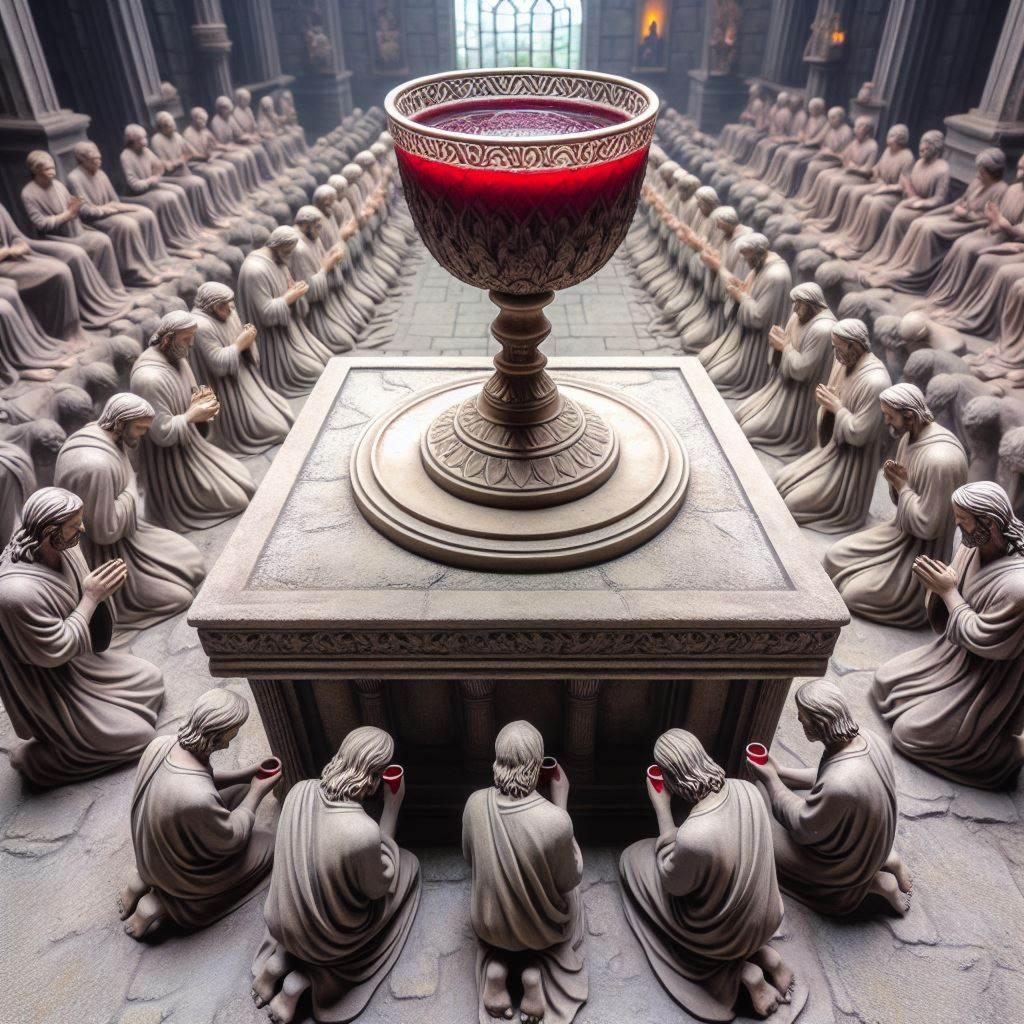
Here, experts in Christianity may say the following: “Isn’t this what the New Testament texts say?” For example: “And He took the cup, and when He had given thanks, He gave it to them, saying, ‘Drink from it, all of you. For this is My blood of the new covenant, which is shed for many for the remission of sins.’” Or: “Having boldness to enter the holiest by the blood of Jesus Christ, by a new and living way…” And so on. There are especially many references to the blood of Christ in the letters of the apostles. In the Epistle to the Hebrews, blood is called “holy,” so it is quite natural that Christians feel a certain religious fear when discussing this topic. Many worship, that is, literally kneel, before a cup of wine or grape juice, which symbolizes the blood of Christ or is proclaimed to be the real blood of Jesus in more orthodox denominations. The law of Moses is impossible to fulfill, efforts are useless, so we are left with the blood of Christ, the grace imparted through it, and the Spirit in which we are made “perfect” of ourselves. Jesus is considered the Savior precisely from this point of view. But is this so in the authentic teaching of Jesus himself?
The contradiction between this worldview and the words of Jesus is especially clear when reading the Sermon on the Mount. There Jesus gathered the Apostles, ordaining them to serve. For example, He told them: “If your eye causes you to stumble, pluck it out and throw it from you.” Other words of Christ also cause misunderstanding, especially about the efforts that a person must make to enter the Kingdom of God or serve: “The kingdom of God suffers violence, and those who use force take it by force.” Isn’t the question of salvation resolved on the basis of the blood of Christ? What other efforts should be made if it has long been clear that, for example, no one can be justified by “the works of the law”?!? What did Jesus mean? Actually, this is the answer to the question of why the authentic teaching of Jesus is not popular: it is too difficult and incomprehensible compared to the doctrine of “justification by blood.” There is even a feeling that many Christians close their eyes to the real personality of Jesus, do not try to understand Him, ignore His instructions out of a completely consumerist attitude towards the salvation of the soul: they need not the real Christ and active communication with Him, but only His blood, as a magical means of receiving saving grace. The words “magical means” may sound offensive to some Christians. However, judging by the deeds of millions of nominal Christians, they understand Christianity precisely as “church magic”, which allows them to consider themselves saved and filled with divine presence regardless of deeds. Justification is by faith, not by deeds, right? An eternal source of controversy and disagreement: the question of the relationship between deeds and faith in Christianity.
Let us return to the personal teaching of Jesus Christ. What did He say about blood? When? How often? What did He mean by this? Undoubtedly, the most significant and significant place for resolving this problem is the text of the sixth chapter of the Gospel of John, where Jesus, among other things, says: “I am the living bread which came down from heaven. If anyone eats this bread, he will live forever. And the bread that I will give is my flesh, which I will give for the life of the world.” Or: “Whoever eats my flesh and drinks my blood has eternal life, and I will raise him up at the last day.” In Judaism, such talk was absolutely unacceptable, since any “drinking of blood” was strictly forbidden in the Torah. Therefore, slightly shocked, the Apostles approached Jesus and demanded an explanation. Jesus answered them this way: “The Spirit gives life, but the flesh is of no account. The words that I speak to you are spirit and they are life.” That is, by the flesh (the bread of life) Jesus meant His Person, Character, and by the “blood” (new wine) – the words He gave birth to, that is, His authentic teaching. The person expresses itself verbally and is known by words. Believers, pondering and looking into the person of Jesus, absorbing His teaching and words, dissolving them in themselves by faith, receive grace, communion with the Spirit and eternal life. And neither the material body nor the blood of Jesus mattered! Only the Spirit, expressed in words, gives real life.
Jesus really taught exclusively spiritual truths and did not allow the worship of any material things during His three years of ministry. Let us recall His words about “worship in spirit and in truth.” However, on the last day, during the Last Supper, Jesus said the following words: “And He took the cup, and when He had given thanks, He gave it to them, saying, ‘Drink from it, all of you. For this is My blood of the new covenant, which is shed for many for the remission of sins.’” Those who hold a more down-to-earth understanding of the relationship between man and God “in the language of sacrifices” immediately saw some material shrine that Jesus Himself allegedly spoke about. But did He really say that we should worship His blood as the main reason for salvation, in the literal sense of the word?
Jesus literally “shed blood,” that is certain. Just as many ascetics or defenders of the country in war shed blood. Jesus’ death and resurrection were indeed God’s plan. Jesus himself said so several times. How are we to understand the New Testament in accordance with all the other words of Jesus? How are we to reconcile the Gospel of the Kingdom and the New Covenant made with the disciples?
The essence of the salvation of a person’s soul, according to Christ himself, is the acceptance by faith of Jesus and His teaching, that is, the Gospel of the Kingdom of God. The Gospel of the Kingdom is that at the invitation of God, a person by the power of faith and love enters the Kingdom of God within himself, is born again and begins to grow spiritually and intellectually, like a plant. This growth can bear many fruits in some, or can end sadly for others. The Gospel of the Kingdom of God “worked” long before Golgotha, during all three years of Christ’s ministry. This means that the New Testament that Jesus spoke of is not at all connected with the idea of a sudden “magical change” of a person through the act of sacrifice. This is not a total forgiveness of sins. The salvation of the soul is more than just the forgiveness of sins. God forgives without any sacrifices, in response to sincere repentance and a promise not to repeat evil. The New Testament is an agreement between God, in the person of Jesus, on the one hand, and man on the other. God promises to be with man constantly in the form of the Spirit of Truth, and to guide his inner spiritual growth. Man, for his part, undertakes to remember the person of Jesus (“do this in remembrance of Me”) and His teaching (“abide in My word”), to love Him with all his heart. Salvation of the soul is the result of knowing God and unity with Him as a result of the New Testament – the union of Jesus and man.
Jesus made the promise and sealed the covenant with his blood, which serves more as a seal, a love pledge, than as a source of grace. The source of grace is not material blood, but the Spirit of God, expressed in the words of Jesus’ authentic teaching. Spirit and Word are one. This is the New Covenant, which leads to gradual deliverance from sins as a result of spiritual growth. Jesus personally called for worship and honor of his words, to abide in them, to do them. The teaching of Christ, as the only true expression of the Spirit of God, is the true object of worship. This is the true “blood” of Jesus, or “new wine,” which saves the believer.
Jesus encoded His message to many generations in the Eucharist. And He did it skillfully and wisely. Different generations of Christians understand the Eucharist according to their level of spiritual and intellectual insight. It is amazing that the blood of Jesus shed on Calvary is very similar to His Teaching, which, like the real blood of Jesus, remained on Earth.
The central message of the New Testament is not that Jesus made us perfect and sinless as if by magic. He works with us and within us if we will only follow Him. This process goes on for years, for a lifetime. It is time to stop deluding ourselves into thinking that we are “chosen and redeemed” and allowing ourselves to make no inner or outer effort because of it. Salvation is a process of changing our minds and hearts, not a reliance on external events like “justification,” “sprinkling with blood,” and being given some “spiritual train tickets to eternity.” There are no tickets. There is no magic. There is no blind grace from God like free electricity. There is work with God. There is a journey of following Jesus. There is effort of the mind and heart. And according to the New Testament, there is a commitment from God to always be with us and to help us. And He will fulfill His promise. The question is only in us: will we remain faithful to the New Covenant with God?















Leave a Reply