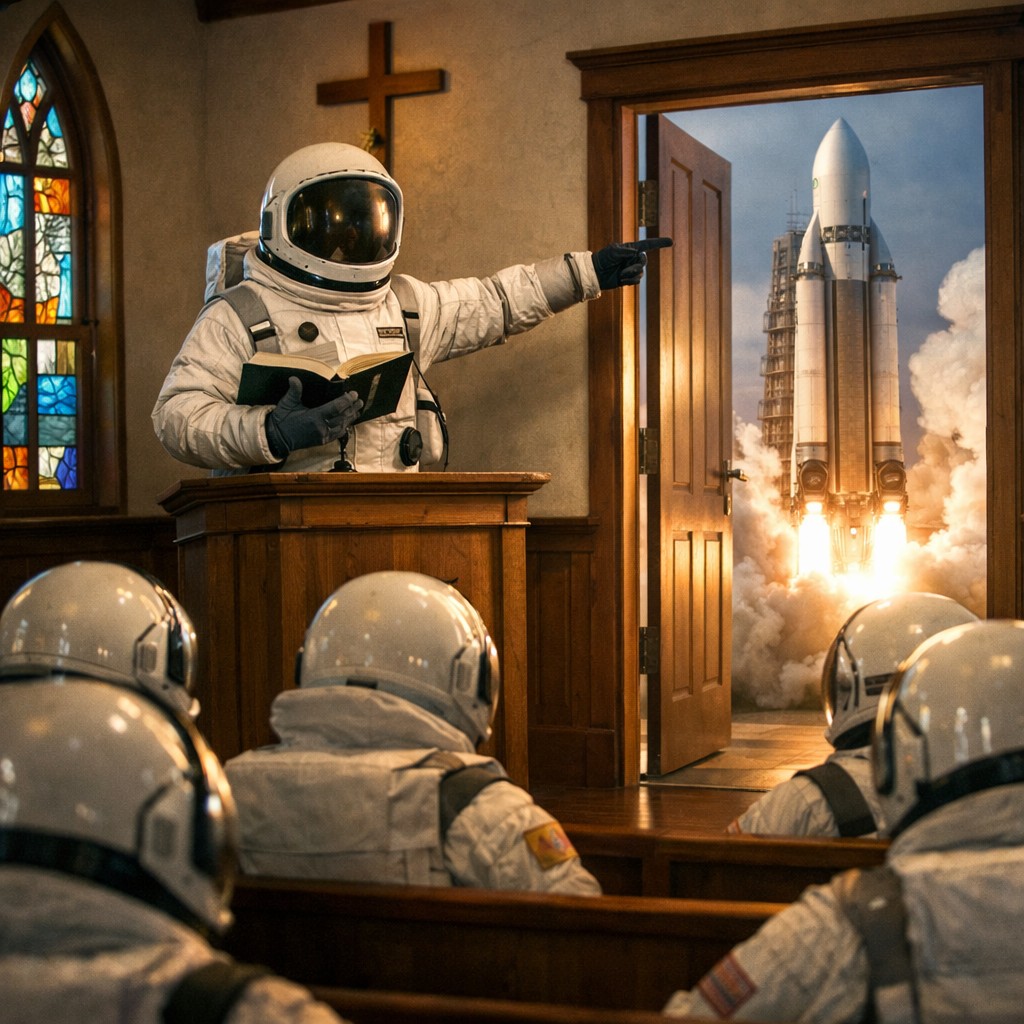
There are different levels of faith. As a rule, the turning point when someone moves to a higher level of faith usually looks like this: “what I believed in no longer holds.” That can be disappointment in people, a crisis of faith, a sense of emptiness, or an inner conflict with dogma. At that point there are two routes: go back and reinforce the religious system, or move forward along the path of spiritual development.
The first, lowest level of faith can be summed up as “I believe because they believe.” Imagine someone entering a church and seeing hundreds of people worshiping and praying. He decides: since I see so many people here, God or higher powers must be real. Unfortunately, this is the most unstable form of faith. Still, it gives a sense of belonging and temporarily removes the fear of loneliness. The object of faith here is people, society—the social mass. This faith is vivid and emotional but shallow: tied to social surges and highly dependent on the opinions of those same people.
The second level is faith in an institution and tradition. A person turns to the church as a historical organism, as continuity, as the authority of a centuries-old tradition. That seems colossal to him. The believer reasons: “This is true because it has been tested by the ages.” Here there is greater stability and depth; an intellectual basis is acquired. However, faith becomes delegated: the believer is convinced that previous generations worked out all the problems and solved every difficulty—though in reality they did not. The believer tends toward a kind of automatic dogmatism, where any inquiry or innovation is condemned. Here we find the foundation of the oldest kind of religious conservatism: confidence in one’s own traditions.
A more advanced version of institutional faith is faith in intermediaries: apostles, prophets. The driving force of this faith is the phrase “I trust those who have seen.” This is stronger than mere trust in one’s denomination because it involves personal trust; faith becomes historical. Yet the problem remains mediation: they believe through others, and the church or denomination can act as an intermediary between the believer and those living witnesses. The institution then claims the right to interpret those intermediaries for later generations.
The third level of faith is faith in texts and teachings. The objects of this faith are the Scriptures, theology, and various doctrines. The believer says: “I believe because it is written.” This is a higher level because the person thinks for himself, analyzes, and compares. He does not blindly trust tradition and tries to work things out on his own. But there is a danger: faith can turn into an intellectual system, into religious-philosophical constructions. This is a fairly lifeless, emotionally dry domain, a kind of desert traversed by people with strong systematic minds. Some get lost in that desert, mistaking mirages for reality.
The fourth level of faith brings a person to an existential plane: he begins to trust the personhood of God. It is a qualitative leap, a move from “I believe in God” to “I trust Him.” Faith here is not based on a system, nor entirely on texts, but on trust in the person. This faith is personal and fairly detached from social institutions; the believer increasingly sees himself as a stranger and sojourner in this world. This faith is not ceremonial, not merely “regular” like weekly church attendance. It is daily, minute-by-minute; it is tightly interwoven with consciousness.
The fifth, perhaps highest, level of faith consists not only of trust but of a sense of unity with God’s person and His Spirit. It is life in harmony, in the closest union, when a person’s mind ceases to be merely an earthly mind. It is not just following, not merely discipleship, not just trust, but an inner coincidence. The Apostle Paul expressed this state: “It is no longer I who live, but Christ lives in me.” Of course, Paul somewhat exaggerates the effect of personal death, yet he tried to convey the idea of a symphony with the divine spirit as best he could. Faith here ceases to be an act; it becomes a continuous state.
Jesus demonstrated what is required to move between these levels. Huge crowds followed Him, yet He easily deflated mass enthusiasms. He refused to be made a king after yet another miracle, demanding a shift from mass movement to a personal decision. He did not treat faith as a collective habit. His words “You have heard that it was said to the ancients… but I tell you” should be read as a deliberate undermining of the level of “faith in authority,” as a destruction of dependence on “that’s just how things are.” Jesus also did not endorse many believers’ conviction in the absolute authority of Scripture. Although He based His teaching on a limited set of texts that He Himself selected, He still required fidelity not to the letter but to the spirit. And finally, in His words “follow Me,” “abide in Me,” “the kingdom of God is within you,” He calls people to move from mediated faith to direct relationship—to trust and even beyond that, to spiritual unity—where faith becomes an inner state.
In the psychology of religion the transition from one level to another is called fixation at the level of support. The problem of spiritual growth is that a person finds a workable form of faith and… stops moving. Because that form satisfies basic needs: security, identity, belonging. Moving further requires not just convictions but an inner risk.
Why do people “get stuck” at a particular rung? At each level a person seeks to solve a specific task. By becoming one of the in-group, he rids himself of loneliness. By accepting traditions he finds stability and “frames of truth.” By mastering the teachings, he gains intellectual clarity. “Intermediaries” provide the assurance that “someone has already checked this out.” When all these tasks are solved, the psyche says: “Enough. Why go further?”
Each step upward is a loss of support. Each next level requires letting go of the previous level and many attitudes that have become part of the psyche: from the crowd to solitude, from tradition to inner responsibility, from text to uncertainty, from intermediaries to direct contact. This feels like an existential risk. Add to that the fear of making mistakes and social punishment. People tend to choose safety over depth. Social and religious systems really do react sharply to free and independent searching. Jesus’ warning that His followers would be expelled from the synagogues should be seen as a historically typical pattern: any religious system inevitably retards people’s spiritual growth by virtue of its conservatism.
Today the majority of Christians are on the second and third levels—believing in the church and tradition or believing in Scripture and teaching. Add to that the many who are on the first level and simply follow the crowd. Christianity is captive to the illusion of its own completeness because it has a system. There is a feeling that everything is clear, while spiritual growth begins where things are unclear. Transitions between levels happen through crisis, conflict, and disappointment, and this clashes with the natural desire for life to be stable and secure. Growth stalls. People revert and strengthen the system. Paradoxically: religion begins as a living experience, then becomes a system; that system protects itself and starts to impede what it originally came from.
Only a few reach the last two levels of faith because they demand inner honesty, the ability to withstand uncertainty, a readiness to oppose religion, and a renunciation of external guarantees. This is no longer simply “belief.” It is an existential stance. It should be noted that people do not get stuck on the lower rungs because they are “weak,” but because the system supports the stop, and because every person harbors his own fear of what spiritual growth might bring. Therefore most Christians live in the zone of “tradition plus teaching,” rarely moving on to personal trust and an inner state. Yet so long as this goal of Jesus’ teaching is not realized, the Christian religious system will remain unstable, cracking and falling apart under social upheavals. The universe requires spiritual growth. The universe awaits change.











Leave a Reply