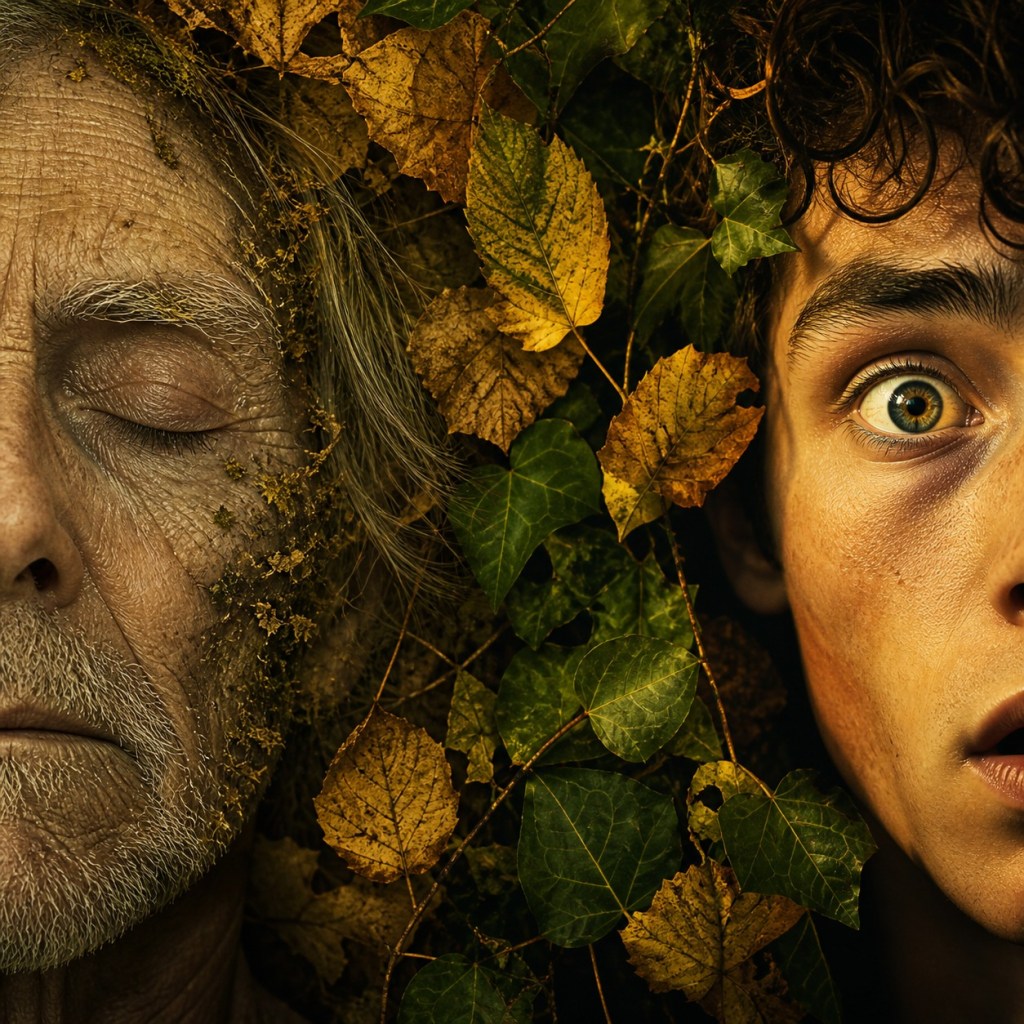
The Apostle Paul was right when he spoke of death and rebirth. For a long time it seemed as if he borrowed that idea from the mystery cults or Stoicism. More likely, though, he spoke from personal experience, and the language of the mysteries merely helped him explain it to people of his day. That was easier for most to understand. Paul once experienced the collapse of an old “self” and the birth of a new person—and called it death and resurrection in Christ.
The problem is that we have turned that experience into a one-off event: an emotional high after which “everything is settled.” That is how religion becomes a clubby, pleasant state—faith as atmosphere and belonging. But it is hardly connected to real inner transformation. Paul himself sounds different: “I die every day.” This is not a metaphor for a single crisis but a life-structure. A person is perfected—that is, reborn—as many times as they are willing to die. A person is spiritually born whenever the previous spiritual version of them dies.
This line runs through the whole Christian tradition. Maximus the Confessor spoke of the path of purification, illumination, and theosis—not as a point but as a prolonged process. Gregory of Nyssa wrote of an infinite ascent: there is no final rung in spiritual growth. Mystics put it even more sharply. John of the Cross describes “dark nights”—not one but a succession of inner destructions. Meister Eckhart says that God is born in the soul again and again—but for that the soul must be emptied.
Even outside theology this pattern is recognizable. C. G. Jung saw personality development as a chain of crises in which former forms inevitably fall apart. Richard Rohr puts it simply: order—decay—new order. And the cycle repeats.
To avoid staying in abstractions, imagine two images.
The first is a seed. It falls into the ground, cracks, loses its shape, as if it disappears. From the outside it looks like the seed has died. But that “death” is the condition for growth. When an ear of grain appears, almost nothing of the original seed remains. If the seed had decided to “preserve itself,” there would be no fruit. This is the very example Jesus used.
The second is a person who loses a job or their health. Yesterday’s identity—status, role, accustomed routine—collapses. It is experienced as a genuine catastrophe. Yet precisely here genuine movement can begin: reassembling oneself, re-evaluating values, the birth of a new inner support. Or it may not begin—if the person clings to the old at any cost.
Both examples say the same thing: growth is impossible without the loss of form. When something “higher” is born, what is “lower” must go. Disappear. Die.
The teaching of Jesus Christ remarkably accurately describes this path. His images are not instantaneous transformations but living growth: the seed, the leaven, the vine. Everything develops, passes through stages, changes from within. It is not a flash—it is life.
Here lies the boundary between authentic spirituality and its ersatz. Religion built on pleasant sensations offers experience without dying. It says: “You are already fine; just hold on to this state.” But the real path says otherwise: “What you are now must change.” And that is almost always painful.
Perhaps Paul had more than one Damascus-like experience. Perhaps he simply did not go into details. But even if it was a single event, the logic of his words still points to a process: “the inner man is renewed day by day.”
From this point of view, the salvation of the soul is a process opposite to aging. In the body a person on earth is subject to destructive processes every minute that shorten life. Imagine the reverse: renewal in which each change in the body accumulates additional capacities and qualities. This is called the process of perfection, when through changes a person gains the ability to live more and more. It is dynamism, transformation, restructuring, constant change for the better. Such renewal and perfection apply only to the spiritual life, not to the physical body.
For most people, to undergo this even once is a powerful experience. It is unforgettable. And heavy. Because each time it is not about adding something new but about losing what seemed to be oneself.
A person is born anew as many times as they are willing to die. Everything else is merely an attempt to circumvent this law.










Leave a Reply