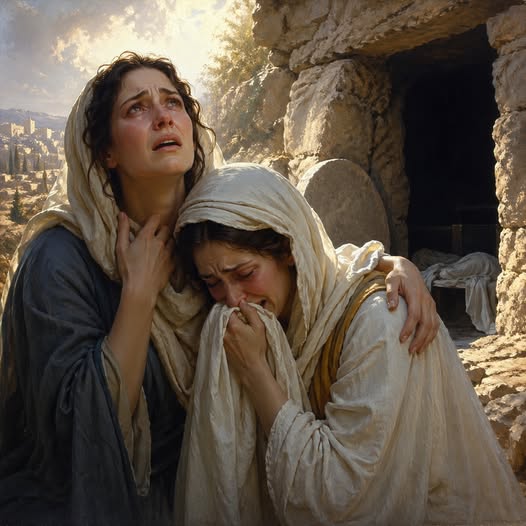
Martha and Mary at first appear as figures of an all-too-familiar human life. They have a home, a brother, an established routine, a relationship with Jesus, and the natural assurance that when it really matters everything will be all right. They know exactly whom to turn to in trouble. They assume that connection with Jesus, by itself, should protect them from the worst outcome. We do this so often ourselves. We build our lives around an unspoken conviction that the essentials won’t collapse: the job will remain, loved ones will stay near, health will hold, the future won’t suddenly shut down. As long as those supports stand, we don’t notice how deeply we depend on them.
The breaking point begins not at the moment of resurrection but at the moment of Jesus’ delay. The brother’s illness worsens, help does not arrive in time, hope dies before their eyes. Then Lazarus himself dies. For the sisters it was more than a family tragedy. With their brother collapses their inner world—their picture of how God ought to act, their trust in the expected order of things. A person suffers not only from the event but from the collapse of the meaning that had held them from within. That is why their words hit so hard: “If only you had been here.” In those words are love, pain, bewilderment, and the beginning of a new, stronger faith.
The two sisters respond differently, just as people respond differently to crisis. Martha goes out to meet him, speaks, seeks support in conversation, as if trying to hold some structure together amid the chaos. Mary weeps and sinks deeper into the experience of loss. One person in trouble begins to act, another to feel, a third falls silent, a fourth grows angry. But external differences do not cancel the common process: both go through an inner dying. The old certainty dies, the old pattern of hope, the previous sense of a controllable world.
The principal miracle does not happen only to Lazarus. The resurrection touches the sisters as well, though in another way. Lazarus comes out of the tomb bodily. Martha and Mary emerge from their own inner night, after unbearable grief and moral devastation. Their brother is returned to them, but their former naivety is not. The house becomes a home again, yet its inhabitants are different. Everything is as it was—and everything is changed. After such events a person knows that love does not guarantee the absence of pain, that God’s silence does not mean His absence, that hope can die and yet be born again in another form.
This story speaks to the modern person. Someone loses the job on which they built their sense of worth. With the position dies the future that had seemed secure. Someone goes through a divorce and realizes that not only the marriage has vanished but an entire version of life. Someone hears a diagnosis and can no longer live with the same sense of time. Somewhere war begins. In all such cases it is not only the external circumstance that dies. The inner world in which a person had already made a home dies too. And if later a new life is born, it is not a return to what was but a resurrection after crisis. A person finds not the same job but a new foundation for the self. Not the same love but a more mature capacity to love. Not the former security but a depth that is not wholly dependent on the external.
It is no accident that the ancient world knew mysteries of death and rebirth. People felt that true renewal required passing through a symbolic death of the old state. But in the story of Lazarus the mystery does not take place in ritual or in the theater of sacred signs. It happens literally in the life of a family. Death comes into the house. Hope is truly buried. And then the new thing arises not as a symbol but as an event. That is why this story is so powerful: it joins the outward miracle and the inner truth of the human soul.
Later Paul will speak of death and new life, of the dying of the old self and the birth of the new person. Those words are often read only theologically, as doctrine or mystical status. But in them one also hears a deep psychological law. The old “I,” built on control, familiar guarantees, and a childish form of hope, cannot merely be dressed up on the surface. It goes through dissolution. Only then does a person emerge who knows the truth more deeply than before. Perhaps Paul’s language describes not only a heavenly mystery but the very path by which God really works within a person—the path to which Christ himself pointed.
Here one of the most difficult modes of Jesus’ action is revealed. He does not always leave our former hopes untouched. Sometimes He allows them to die so as to raise us with them on a different, deeper level. This is experienced as loss, as darkness, as a delay of help. But later it becomes clear: not everything has vanished. Only the form of life that had become too cramped for future growth has died.
The story of Martha and Mary shows that God works not only through consolation but through transforming crisis. We ask to have yesterday’s world restored, and sometimes in return we are given our tomorrow selves.














Leave a comment