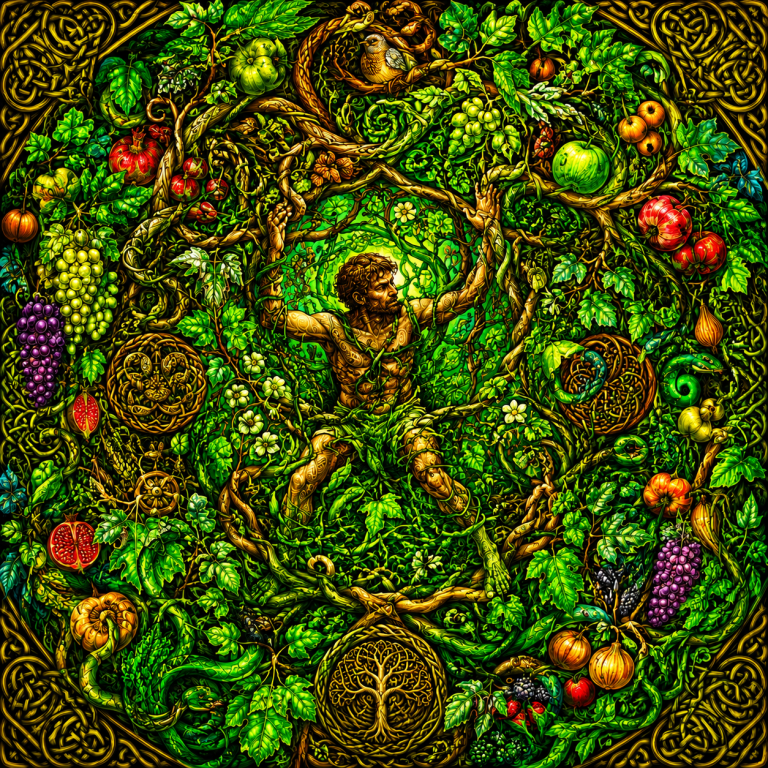
One of the central thrusts of Jesus’ teaching is that the life of the Kingdom of God is an organic process of growth, not a static condition. For Jesus almost all the primary metaphors are dynamic: seed, leaven, the vine, birth, fruit, water, the way. For him, everything alive either grows and bears fruit or withers and dies.
Spiritual growth is always associated with the emergence of the new. New thinking. New perception. New depth of feeling. New capacity to love, to understand, to endure, to see. A person who is growing spiritually cannot remain inwardly identical to the person they were years ago.
A plant’s growth means that today it is where it was not yesterday. Life constantly moves beyond itself. Therefore any development contains both creation and destruction: the old state dies so that the new can arise. That is why Jesus so often uses the word “new”: new wine, new birth, a new commandment, a new person, new wineskins, fruit, harvest. Christianity, at its deepest, is not the preservation of personality but its continual transformation.
If a person remains inwardly the same for decades, if nothing new arises in them — no thought, no depth, no mercy, no understanding, no inner freedom — the question must be asked: is that spiritual life alive at all?
This is precisely where the parable of the talents becomes especially illuminating. The servant who buried his talent in the ground was not necessarily committing an obvious evil. His problem was a lack of development. He preserved, conserved, but did not multiply. He did not enter into the process of creative growth. This is crucial: the parable condemns not only the sin of action but also the sin of stopping.
In effect this person chose psychological and spiritual immobility. Fear caused him to refuse growth: “I knew you to be a hard man… and, afraid, I went and hid your talent in the ground.” In other words, fear breeds the preservation of the self. And preservation is the opposite of life.
In nature, lack of growth almost always signals the beginning of death. A living organism is in constant exchange of matter, renewal, adaptation, and increasing complexity. Even the body’s cells are continuously replaced. Life is a process. Stasis is more characteristic of a stone than of a tree. Peter once called Christians “stones,” but living stones — emphasizing the idea of development. Therefore, in Jesus’ logic, spiritual immobility can be regarded as a form of inner dying.
A personality that does not develop begins to build defensive mechanisms to preserve itself. A person increasingly lives by automatism, habitual reactions, and an old identity. Inner rigidity appears. This is why religious systems so often become antagonists of a living spiritual experience: a system wants stability, while life demands transformation.
Jesus, by contrast, constantly disrupts a person’s former structure: Nicodemus is told about being born anew. The rich young man is asked to tear down his old supports. The apostles go through crises and the shattering of expectations. After his denial, Peter becomes a different man. Who knows how many such breaking points Peter experienced after that? Probably many. A disciple of Jesus almost never remains the same.
The salvation of the soul is not merely a legal status but the preservation of the soul’s capacity for further development. Hell, understood this way, is not only punishment but the final crystallization of a personality incapable of change. And the Kingdom of God is an endless movement into the depths of life.
This theme appears in many thinkers. For Carl Jung, the development of personality (individuation) was a continuous becoming of a new person through the integration of previously unknown parts of the psyche. Stopping the development of personality leads to neurosis and internal disintegration. Such neuroses and destructive crises are characteristic of conservative Christians who live without creative development.
Søren Kierkegaard wrote that a person can “become despairing and freeze in the self” by refusing to become who they ought to be. Nietzsche constantly used the image of overcoming the human; for him the tragedy is not falling but halting. For Henri Bergson life was the élan vital — a creative impulse constantly generating the new. Abraham Maslow believed that higher forms of mental health are directly tied to self-actualization and inner growth. A person who ceases to grow begins to decline psychologically.
Nowhere does Jesus call simply to “preserve yourself.” On the contrary: “Whoever loses his life for my sake will find it.” That is, the loss of the old form of personality becomes the condition for the birth of the new. This is the biological law of the Gospel: a seed cannot remain a seed and at the same time become a tree.
In conservative Protestantism, salvation is usually understood primarily as a change in a person’s legal standing before God. The main question there is: “How can a sinner avoid condemnation and receive justification?” The biological conception of Jesus’ Gospel shifts the center in another direction: “Is the person becoming more alive, more whole, and more capable of spiritual growth?”
In classic evangelicalism a person can be considered “saved” even if their inner structure changes little, provided they have the right faith and confession. Yes, there is a theme of sanctification, but it is often secondary to justification. Practically, this sometimes leads to a model: “The main thing is to accept the right Gospel and be confident of your salvation.” In the biological Gospel model that would be insufficient. A faith that does not grow may be dead.
Conservative Protestantism often rests on the category of security: “Am I saved?”, “Will I lose my salvation?”, “Do I have enough faith?” The concept of a living Gospel is built around the category of life: Am I growing? Is transformation taking place? Is anything new arising? Am I becoming more alive? These are different spiritual languages. In evangelicalism salvation is usually seen as a solution to the problem of guilt. In the living Gospel framework salvation is closer to a solution to the problem of immaturity, inner death, and the unrealized human nature.
A conservative Protestant would say: “Growth is a consequence of salvation, not its cause.” A proponent of the living Gospel would say: “A lack of growth may indicate a lack of genuine salvation.” Here lies the main dividing line.
There is no logical contradiction between these two claims. Moreover, in theory many conservative Protestants would also agree with the second claim — at least partially. The problem is not logical but in where the emphasis is placed and the practical consequences that follow.
Conservative Protestantism is usually afraid of making growth too strong a criterion of salvation. Why? Because then there arises the risk of constant anxiety, self-analysis, fear, the feeling that one must earn salvation by developing oneself. So many evangelicals deliberately place the primary emphasis on trusting Christ rather than on measuring one’s own transformation. They fear replacing grace with “spiritual productivity.” That scares people away and sets an exceptionally high bar for pastors and ministers.
A conservative Protestant might say: “Even if a person is weak, confused, spiritually dry, and barely changing, they can still be saved by grace.” The biological Gospel model will ask: “But if nothing has been born for decades — where is the life?” The simplest way to explain the difference between the two theories is this: in conservative theology salvation is thought of as a “point” after which everything is settled. The Gospel, as Jesus taught it, asserts that salvation is a line, a process that takes time. There is indeed a first point on the line, but whether there will be other points along the line of growth is the crucial question.
Jesus gives another clue as to what salvation is. It is not only the first point, not only the line of growth. Yes, growth is not enough! One must reach the phase of fruit. The essential thing inside the fruit is the seed. In other words, the fruit is not simply the result of life; it is the mechanism for its continuation. A tree, through its fruit, reproduces its nature elsewhere and in future time. If growth is inward transformation, the fruit is the outward manifestation of the new nature, and the seed within the fruit is the capacity of that new nature to be passed on to others.
Fruit is connected to the multiplicity of life. Life does not turn back on itself. It spreads. A biological, natural understanding of spirituality is this: true spiritual life is always reproductive. It produces life beyond itself. A courageous person begets courage; a free person infects others with freedom; a loving person makes love psychologically possible for others; someone who has overcome fear becomes living proof that fear is not absolute.
Spiritual fruit is not simply moral behavior; it is the transmission of a life-structure into society. Barrenness in Jesus’ teaching can mean not merely a lack of “good deeds,” but an inability to pass life on. A person can exist, consume, know doctrines, belong to a religion, and yet produce no new movement of life around them.
The salvation of the soul is not a legal entry in some heavenly database but participation in a chain reaction of endless life, in which a person becomes soil, seed, tree, and also the fruit of another’s growth. In that case life continues. And life really should continue — for the sake of our children, for all future generations, for our whole planet.














Leave a Reply