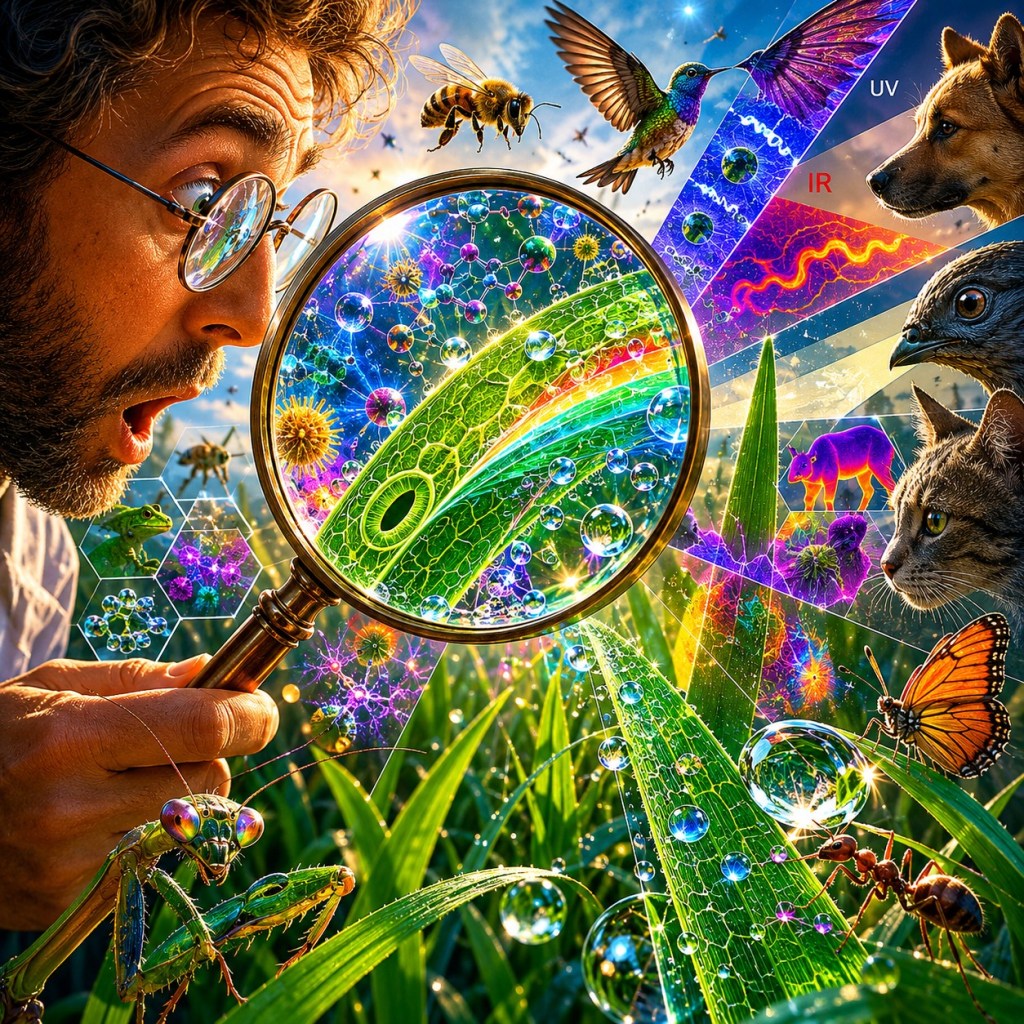
People see grass as green. But grass does not have color in the absolute sense. Different biological beings see grass differently. What we call color is the result of the interaction between light, an object’s surface, the observer’s eye and brain. So grass appears green to a human because chlorophyll in the leaves absorbs mainly red and blue wavelengths and reflects green ones. Those reflected wavelengths reach our eyes, and the brain interprets them as the color green.
Different creatures have different visual sensors: a dog sees a world poorer in colors; bees see ultraviolet, which humans cannot see at all. Some birds perceive far more shades of green and UV-patterns on plants; snakes can perceive infrared as a thermal image. That is, the same grass is green to a human, perhaps patterned with bright ultraviolet markings to a bee, a dull yellowish-gray to a dog, and for beings with yet other kinds of vision it would be something unimaginable to us. For this reason philosophers and neuroscientists often say: color is not a property of an object but a model created by the brain.
An object has physical properties — for example, which wavelengths it reflects. But “greenness” as an experience arises inside consciousness. One can say: grass is not “green.” It reflects a certain band of electromagnetic waves that the human brain experiences as the color green. If every creature sees the world its own way, what is the world “in itself,” independent of any observer? Science still has no complete answer to that question. And what would the world be like for an omniscient, all-knowing observer equipped with every possible ideal sensor?
Such a hypothetical observer would probably not see grass “in color” in the human sense at all. We see a very narrow, simplified interface of reality: a small range of the electromagnetic spectrum, a limited palette of colors, simplified shapes, a smoothed picture of the world. An omniscient observer would not perceive a finished green object but a vast, multilayered system of processes at once. Grass for such an observer might appear as a flow of photons of different energies, movement of electrons in chlorophyll molecules, quantum transitions, heat exchange, evaporation of water, cell growth, the chemical reactions of photosynthesis, interactions with bacteria, fungi and insects, the exchange of carbon with the atmosphere, genetic activity. In other words, not a static “green thing” but a dynamic field of processes. One could even say: we see the symbol of grass, while such an observer would see the full structure of reality.
For that observer there is no separation between color, shape, time, energy and matter, because in modern physics these are deeply interrelated. For example: matter is a form of energy; color is an interpretation of wavelength; hardness is the result of electromagnetic interactions between atoms; an “object” is a persistent process rather than an absolutely separate thing. An observer at the “God” level, seeing all this multiplicity, would simply know that a person merely sees grass as green.
Human perception evolved not to apprehend truth but to ensure survival. We do not need to see quantum fields or the infrared spectrum. We only need to tell edible from inedible, navigate, notice motion, recognize faces. So green grass is a kind of “icon” of reality, like a folder icon on a computer. The icon does not show the true structure of the data on the disk — it is merely a convenient interface. The absolute observer does not see this “grass icon” but the entire source code and all the system processes at once. Obviously, such an observer would not be human.
Many philosophers conclude that the color green should not be dismissed as a mere “illusion.” Even if green arises in human consciousness, it is still connected to objective reality and does not appear randomly. If all normally sighted people see grass as roughly green, then there really is something stable in the world that human consciousness consistently experiences as green. In that sense greenness is not just the brain’s fantasy. It is a repeatable correspondence between the structure of the world and the structure of human perception. Grass is truly green for the human mode of existence in the world, and not absolutely green for every possible being in the universe.
Jesus taught, “Know the truth, and the truth will set you free.” Humans live among symbols and surfaces. We see reality through many filters: distortions of fear, ego, culture or biology. Grass seems simply green to a person, but behind that “greenness” lies a vast depth of reality: light, energy, life, interconnection, processes, dependence on the sun, time, death and growth all at once. In the same way, according to the Gospel, people see: the rich as successful, the sinner as corrupt, the sick as punished, the cross as defeat, the kingdom as a political power. Christ constantly dismantled this superficial mode of perception. He seems to say to us: “You see the green, but you do not see reality and truth itself.” We respond: “The grass is green; that’s obvious, and not worth arguing about.”
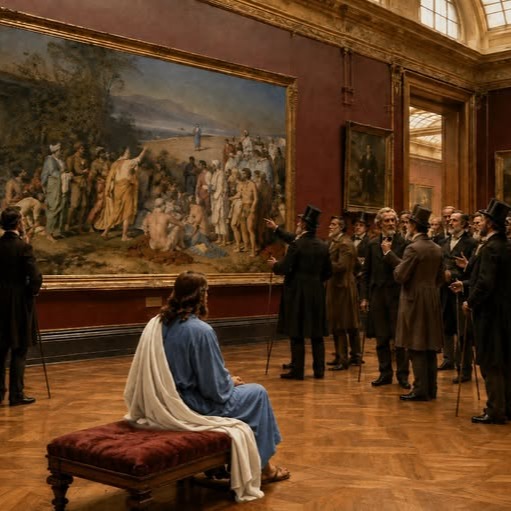
Human consciousness does not see the world as it is but a simplified interface of it. The Gospel is Christ’s attempt to break through that interface. We see grass as green not because we know its whole essence, but because our minds can perceive only a limited range of reality. A person sees their neighbor through fear, ideology, religion, social status, grievances. But Christ in the Gospel acts as an absolute observer — He sees what others do not.
The main miracle of the Gospel is not only its morality but a new kind of vision: “He who has ears, let him hear,” “He who has eyes, let him see.” These are all about the imperfection of human perception. If grass is not just green but infinitely deeper than our perception, then how much deeper is a person than the labels we attach to them? Christ’s teaching is not simply religion, morality or ecstatic experience, but an invitation to go beyond surface perception. That stepping beyond human existence is what is called “spiritual rebirth,” and the subsequent spiritual growth is the unveiling of the Universe as God himself sees it. That is what the Gospel of Jesus Christ is.















 Follow Jesus Christ
Leave a comment