The word “biological” in the modern world is often associated with materialism, the reduction of a person to chemistry, Darwinism, and a purely physical life. So some readers might mistakenly think that here spirituality is being reduced to the biology of the body. Not at all. Jesus described spiritual life as a living, organic process, not as a legal declaration, and there is a very solid textual basis for that in the Gospels. Here the term “the Biological Gospel” is only one way of expressing the essence of Jesus’ authentic Gospel.
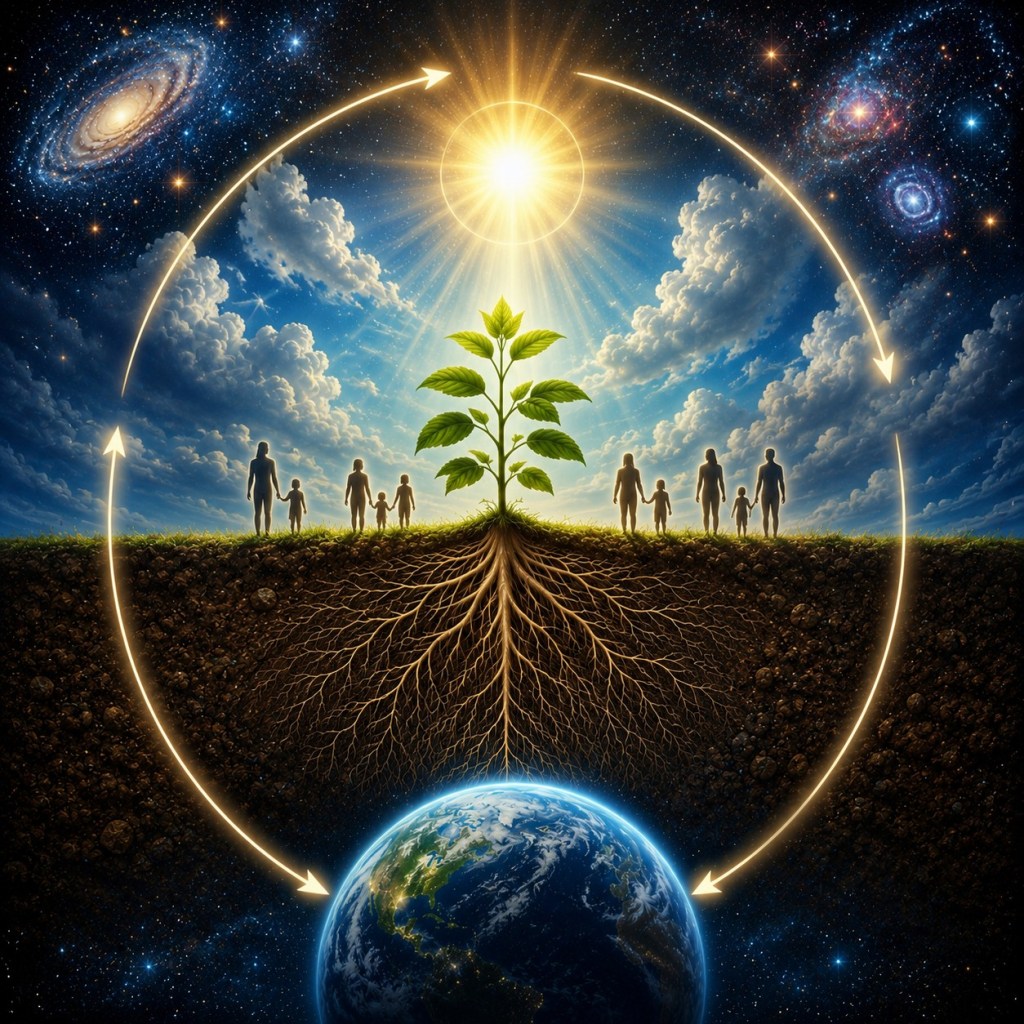
A human being is a point that closes a circuit, like a plant that connects the movement of the elements of the earth from below with light and air from above. A person is a union of many forces and mechanisms of the universe. We depend on external phenomena and are not completely closed, autonomous, or self-sufficient creatures. Just as a modern smartphone depends on electricity and an internet connection, a person also depends on external sources of life. Deprive a smartphone of internet or power and it quickly begins to malfunction and decline. In the same way a person lives by forces and influences both from within and from without. Jesus’ teaching constantly compares people to plants, seeds, and trees. Life is existence in dynamic interaction with the environment. The Gospel is a teaching about how a person lives and develops in the universe.
Jesus very often explained spiritual reality through living, growing, organic processes — not merely as pretty metaphors, but as a model of the very nature of the Kingdom of God. When Jesus speaks of God’s life, he almost always turns to biological language: growth, fruitfulness, birth, nourishment, breathing, body, seed, tree, and the vine. When he speaks of what is dead, false, or external, he more often uses architectural, legal, economic, or mechanical imagery.
One of the central images is the grain: “The kingdom of God is like a grain…” The seed is hidden, dies, germinates, develops from within and contains the potential of a future tree. This is almost a ready-made model of the inner transformation of personality, the emergence of a new self-awareness. “Unless a grain of wheat falls into the earth and dies, it remains alone; but if it dies, it produces much fruit.” This is not simply a moral; it is a vivid and fundamental example grounded in the organic basis of life.
“You must be born again.” Not “receive a status,” not “sign a contract,” but be born. Birth is the beginning of a new nature, a new organism, a new life and gradual development. Even the word “rebirth” (regeneration) in Jesus and the apostles sounds biological.
One of the most organic images in the whole Gospel is: “I am the vine; you are the branches.” Here salvation is not described as a contract but as nourishment, sap, connection, the circulation of life, and abiding. A branch does not “fulfill the law of the vine.” It lives from it. This is almost the biology of a mystical organism.
Jesus constantly links inner condition and outward result. “A good tree cannot bear bad fruit.” Here a person is not a mechanism or a legal object but a living organism. Fruit is the natural expression of a tree’s nature. Crucially, fruit contains seed — life reproduces itself. This helps explain that true spiritual fruit is not merely a “good deed” but the ability to pass life on, to awaken growth in other people.
The shepherd and the sheep — even here the image remains alive: voice, recognition, following, attachment, care. These are not boss-subordinate relations. Leaven is also a biological process: an invisible internal change of the whole mass. With the apostle Paul this line is further developed: the body of Christ, the members of the body, the growth of the body, nourishment and the building up of the organism. This continues Jesus’ organic logic.
Jesus does use non-biological forms as well. Interestingly, they are often employed to criticize, warn, and describe external religion, judgment, and social relations. House and foundation: “built the house on the rock” — an architectural image, yet even here the point is the stability of life. Coins, debts, and talents are economic and legal images: debtors, owners, accounting, and management. Even here the idea of growth is often present: a talent must be multiplied, not lie dead. Nets and fishing are occupational images. A lamp is a physical image. Door, way, and gates are spatial and architectural images.
If you look at the emotional center of Jesus’ teaching, living forms turn out to be primary. He almost never describes the Kingdom as a system, an institution, a code, a mechanism, or an ideology. He describes it as growth, life, birth, nourishment, rooting, fruitfulness, connection, and the movement of life through an organism. Thus the term “the Biological Gospel” can function as a contrast to a mechanical, legalistic, or purely dogmatic understanding of salvation.
If you develop the concept of a “Biological Gospel,” then salvation and spiritual life begin to look not like a one-time legal event but like the maintenance and development of a living organism. What does any living form need to live, grow, and bear fruit?
– Nourishment. Without nourishment the organism begins to break down. For Jesus: “I am the bread of life.” “Man shall not live by bread alone.” “Whoever eats… will live.” Food here is not merely information; it is the internal assimilation of life. As the body converts food into itself, a person must internally assimilate truth, love, spirit, and the experience of God. It is no accident that Jesus often says not simply “listen” but almost physiologically: eat, drink, abide.
– Light. A plant without light becomes deformed or dies. For Jesus: “I am the light of the world.” Light reveals, orients, and makes growth possible. Psychologically this can mean awareness, honesty, the ending of self-deception, and the capacity to see reality. A person living in falsehood or repression will become spiritually warped.
– Water. Almost all living things depend on water. For Jesus: “living water,” “the wellspring of water springing up to eternal life.” Water is one of the best symbols of movement, renewal, fluidity, and inner enlivening. Stagnant water begins to rot. The same is true of the human psyche.
– Roots. Without roots a plant falls over. Jesus uses this image explicitly: “they had no root in themselves.” Roots mean depth, stability, connection to a source, and hidden inner life. A vital idea is that the main part of a tree is invisible. This is a strong argument against religious theater and purely external spirituality.
– Soil. Even good seed dies in bad soil. The Parable of the Sower essentially describes psychological conditions: superficiality, fragmentation, anxiety, preoccupation with wealth, and closedness of heart. Thus the problem may not be the seed but the condition of the internal environment.
– Time. You cannot instantly grow an organism. In Jesus the Kingdom almost always develops gradually: seed, growth, maturation, fruit. This opposes religious magical thinking: “I prayed and instantly became perfect,” “God touched me and I obtained eternal salvation.” Spiritual growth — and salvation itself — is the result of time and development.
Perhaps this is the main summons of the Gospel. Not merely to observe, agree, or belong to a system. But to live. To live deeper. To live with more attention. To live so that movement, breath, light, and growth arise again within. Because all living things tend toward life. And perhaps God speaks to a person precisely through this mystery of the living world, which still continues to grow, reach for the light, and bear fruit.












Leave a Reply