When we switch on a lamp, it seems as if the light appears instantly. You flip the switch — and a dark room is filled with light. But if you look more closely, you’ll find that light is not the first link in that chain. It is always preceded by another process.
In an ordinary incandescent lamp electrical energy comes from outside. It passes through a thin tungsten filament and gradually heats it to an enormous temperature. Only after that does it begin to glow.
When tungsten first starts to heat up, its light is almost imperceptible. A faint reddish glow appears at first. Then it grows brighter, moves into orange hues, then into yellow. At temperatures around 2500–3000 degrees the filament begins to emit a bright white‑yellow light capable of illuminating a room. The higher the temperature, the whiter the glow becomes.
Tungsten was not chosen for lamps by accident. It is one of the most heat‑resistant metals on Earth. Its melting point is over 3400 degrees. Most other metals would have melted long before they began to shine brightly. Tungsten can withstand an enormous flow of energy and retain its properties for a long time. It seems made for converting the invisible movement of electricity into visible light.
But why does heating occur at all? Imagine a long corridor. If one person walks along it, they move freely and hardly notice the surroundings. But if the corridor is full of people, a very different picture emerges. There are collisions, delays, the need to swerve around others, to constantly change direction. The denser the crowd, the more effort is required to move.
Something similar happens inside a conductor. Electrons move through the material and constantly collide with the atoms of the substance. These collisions create resistance. Part of the energy is turned into heat, and at sufficiently high temperature light appears.
If there were no resistance, electrons would simply fly through the conductor, changing almost nothing. The filament would remain cold and dark. Light is born precisely because energy encounters resistance on its way.
Interestingly, a candle works on a very similar principle. Many think that the wax itself is what shines. In fact the flame first melts the wax and then vaporizes it. Tiny particles of carbon — soot — are formed inside the flame. These particles are heated to high temperature and begin to glow. It is they that produce the warm golden light that has accompanied humanity for millennia.
A candle’s light is yellow because its temperature is considerably lower than that of a tungsten filament. There is not enough energy for a bright white glow, so we see a soft golden hue. This light lit homes, workshops, temples, and roads long before electricity appeared.
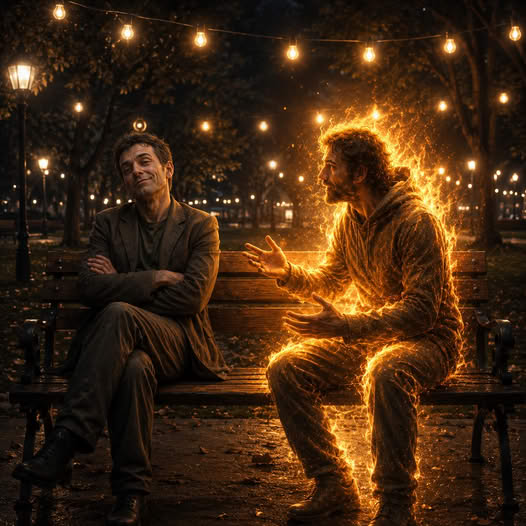
There is something strikingly familiar in this whole picture. Jesus often spoke about light. “You are the light of the world.” “Let your light shine before others.” In the New Testament images of light, fire, and burning recur again and again. Of two disciples after meeting Christ it is said, “Did not our hearts burn within us?” John the Baptist is called a burning and shining lamp. Even on the day of Pentecost the action of the Spirit is symbolized by tongues of fire.
We use similar expressions in everyday speech. We say, “He was fired up by an idea.” “She’s passionate about her work.” “His eyes are alight.” These words make sense even to people who have never opened the New Testament.
Curiously, no one can command themselves to shine. You can force yourself to smile. You can force yourself to get a task done. You can even force yourself to look confident. But you cannot directly produce an inner light. Light is always the result of some deeper process.
That is why people far from religion sometimes shine far more brightly than those who talk a lot about faith. Someone is consumed by scientific research. Someone devotes themselves to art. Someone lives to help others. Inner fire does not come from belonging to a certain group. It arises where a person is truly engaged in something larger than themselves.
So what creates this inner heating? First of all — the presence of a high ideal. Without ideals a person seldom feels serious inner tension. They live as best they can, adapt to circumstances, try to avoid unnecessary difficulties. They simply exist. But everything changes when an image of who they want to become appears before them.
Every genuine ideal creates a gap between the present and the desired. Energy for growth is born in that gap. As long as there is distance between the person today and their future image, movement forward continues.
The teaching of Jesus raises that standard extraordinarily high — unimaginably high. It concerns not only deeds but the very character of a person. Love your enemies. Bless those who offend you. Forgive. Be merciful. See dignity even in those whom society has learned to reject. Strive for absolute perfection and to become a son or daughter of God Himself!
Love occupies a special place here. Love requires energy. It requires time. It requires attention. It requires the ability to listen, to understand, and to forgive. Very often love requires sacrifice. That is why it becomes not just a pleasant feeling but a powerful source of inner tension.
Every time a person chooses love instead of indifference, patience instead of irritation, forgiveness instead of revenge, work is done inside. Gradually this work changes character in the same way an electric current gradually heats a filament.
Here the first secret of light becomes apparent. Neither a candle nor a lamp can shine by themselves. A lamp needs an electric current. A candle needs a flame. The source of energy is always outside them.
That is why Jesus so often spoke of the need to remain in Him and to remain in the Spirit. He did not call people to produce an endless supply of spiritual energy on their own. On the contrary, he spoke of a constant connection with the Source of life. If the flow of energy is cut off, the glow gradually fades.
The second secret is connected with the material of the filament itself. Not every material can withstand intense heat. Sometimes a person is tense, overloaded, and busy from morning till night, yet no light appears. Irritation appears instead of light. Fatigue instead of warmth. Destruction instead of inner growth. Not every strain makes a person better.
For light to appear a certain inner material is necessary: honesty with oneself, the ability to admit mistakes, openness to truth, readiness to learn and to change. These qualities are what allow life energy to be transformed into personal growth rather than into burnout.
The third secret of light is related to resistance. We usually treat resistance as an enemy. We want things to happen easily and without obstacles. But the lamp reveals a surprising law: without resistance there is no light at all. If electrons flew freely through a tungsten filament it would stay cold and dark. Light appears precisely because movement meets many obstacles and collisions.
Perhaps the world is arranged similarly. We encounter the perspectives of others, our own mistakes, failures, disappointments, difficult people, unexpected circumstances. Each such collision makes the mind work. We begin to ask questions, to revise our convictions, to seek a deeper understanding of life.
That is why one of the most dangerous phrases can be: “That doesn’t concern me.” Someone else’s pain doesn’t concern me. Injustice doesn’t concern me. Another person’s fate doesn’t concern me. The truth that requires change doesn’t concern me.
But what concerns us becomes the material for inner growth. The world seems designed to confront human consciousness with reality. Through these collisions heating occurs. Through heating maturity comes. And maturity, over time, begins to shine.
If energy is available to all people, why then do so many never begin to shine? The question resembles Jesus’ parable of the sower. The same seed falls on different soil. Somewhere it dries up quickly. Somewhere it is choked by weeds. Somewhere it simply cannot take root. Only some of the seeds bear fruit. The problem is not the seed. The problem is the condition of the soil.
In the same way the stream of life passes through each person. But not every inner material is able to transform that energy into light. Sometimes fears interfere. Sometimes a habit of comfort does. Sometimes indifference. Sometimes the lack of high ideals.
Perhaps that is why the words “You are the light of the world” were spoken in the Sermon on the Mount, addressed to the Teacher’s closest disciples. These people had already made the choice to follow him and to allow his words to change their lives.
The light of personality does not appear immediately. The apostles’ inner light emerged only after years. It was preceded by years of reflection, mistakes, struggle, inner conflicts, revision of views, and gradual growth. Many people live at room temperature in the soul. They avoid deep questions, try not to notice what requires change, and therefore remain almost unchanged.
Heating is not suffering for suffering’s sake. It is the response of a living person to the call of God. It is a person’s answer to the stream of life that continually passes through them. Light turns out not to be an end in itself. It becomes the natural consequence of steady inner development.
Just as in a lamp heating comes first and then the glow, so in a person the soul must grow first and only then do its fruits appear — wisdom, kindness, patience, courage, compassion, and love. Then others begin to notice a light that cannot be switched on by command and cannot be faked. “The light shines in the darkness, and the darkness has not overcome it.”














Leave a Reply