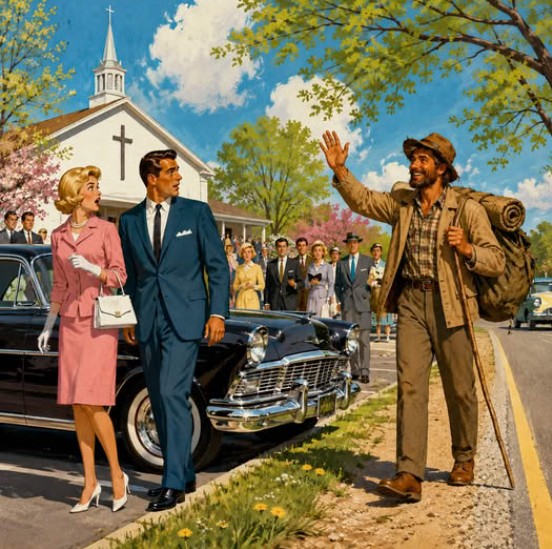
The Way is older than Christianity. That sounds surprising, yet that is exactly how the early movement of Jesus’ followers is described in the book of Acts. Before the word “Christian” appeared, there was another designation — “the Way.” It first appears in chapter 9 of Acts, where Saul receives letters to persecute “those belonging to the Way.” The expression then recurs again and again: Acts 19:9, 19:23, 22:4, 24:14 and 24:22. Only later, in chapter 11 of Acts, do we read that the disciples “were first called Christians in Antioch.”
This distinction matters not only historically but psychologically. The word “Christian” denotes membership in a particular community. The word “the Way” denotes movement. It implies direction, process, change — an inner transition from one state to another. For the ancient world a way was not merely a road. It signified a way of life, a mode of thinking, a practice of being.
Picture a young man who leaves a noisy town at night and begins to climb a mountain road. Below him are glowing windows, quarrels, habits, fears, the struggle for status. The road ahead is hard and at times dangerous. He has not yet reached the summit; he doubts often, he stops sometimes, but the main thing is that he keeps going. This, probably, is how the early disciples experienced following Jesus.
Jesus himself said, “I am the way.” Those words from the Gospel of John take on particular depth in the light of Acts. Perhaps the meaning was not only about a doctrine of salvation but about a mode of existence. Jesus was the Way in the sense that his life became the direction of movement for others. To follow him meant not merely to accept certain ideas but to begin to change from within.
The first disciples lived like that. They left their old ways of life, argued, erred, feared, and rose again. Peter gradually traveled the path from an impulsive man to a person capable of accepting suffering. Paul — from religious fanaticism to an inner conversion. Even doubting Thomas was not rejected for his lack of certainty. The Way presupposed a process, not instant completion.
Over time Christianity became an institutional religion. That was almost inevitable. Without organization, structure, theology, and discipline the movement probably could not have survived in history. The church preserved texts, culture, the memory of Christ. Yet alongside that there occurred an important psychological shift. The emphasis gradually moved from movement to membership.
For a person on the Way the decisive question is: “Am I changing?” For institutional consciousness the question is often: “Do I belong to the right system?” In one case faith is understood as a process of inner growth; in the other, as confirmation of status, doctrine, or religious identity.
This produces a paradoxical situation at times. A person can spend years inside a church structure, know theological formulas, take part in rites, and yet remain almost motionless inwardly. He lives as if at the foot of the mountain, studies the map of the route in detail, argues about the right path — and never begins the ascent.
The Way is always connected with risk and change. One who walks it cannot fully preserve his former self. That is precisely why the idea of the Way is more disturbing than the idea of religious belonging. Belonging gives stability. The Way requires movement.
And yet the history of Christianity shows that even inside the institutional church there have continually appeared people who returned to this ancient idea — for example, Francis of Assisi or Søren Kierkegaard. They perceived faith not as a completed system but as an ongoing ascent toward light, truth, and inner renewal.
Perhaps that is why the word “the Way” does not disappear from the text of Acts by accident. It reminds us that at the very beginning Christianity was less an organization than a road. That means all those who walk in the way of Jesus, even if for whatever reason they do not belong to institutional churches, are nonetheless part of the church. Only this church is dynamic, moving, informal. In this church there is no need to pretend to be righteous; there is no need to worry about structure and offices — they simply do not exist. This idea can be defended historically, theologically, and psychologically. It does not seem wholly alien to early Christianity.
The first Christians often had no temples or elaborate structures at all. They met in houses, in small groups, around teachers, around the shared memory of Jesus. Thus the idea that the church can exist as a living network of people, not only as a formal organization, has solid grounds. The institutional church is a fixed form of Christian community. The dynamic church is the process of living following of Christ, which can partially extend beyond formal structures. Jesus himself acted rather unusually for the religious systems of his time. He did not create a rigid bureaucratic structure. He created a circle of people on the move. The disciples literally followed him — on roads, between towns, through crises and inner changes.
Not every institutional affiliation means the Way. Nor does every solitary search automatically become the Church. The church, in the deep sense, arises where people are oriented toward Christ, are inwardly changed, keep connection with one another, bring one another light, help and correction, and continue to move. Then the church becomes not merely a place but a living phenomenon.














Leave a Reply