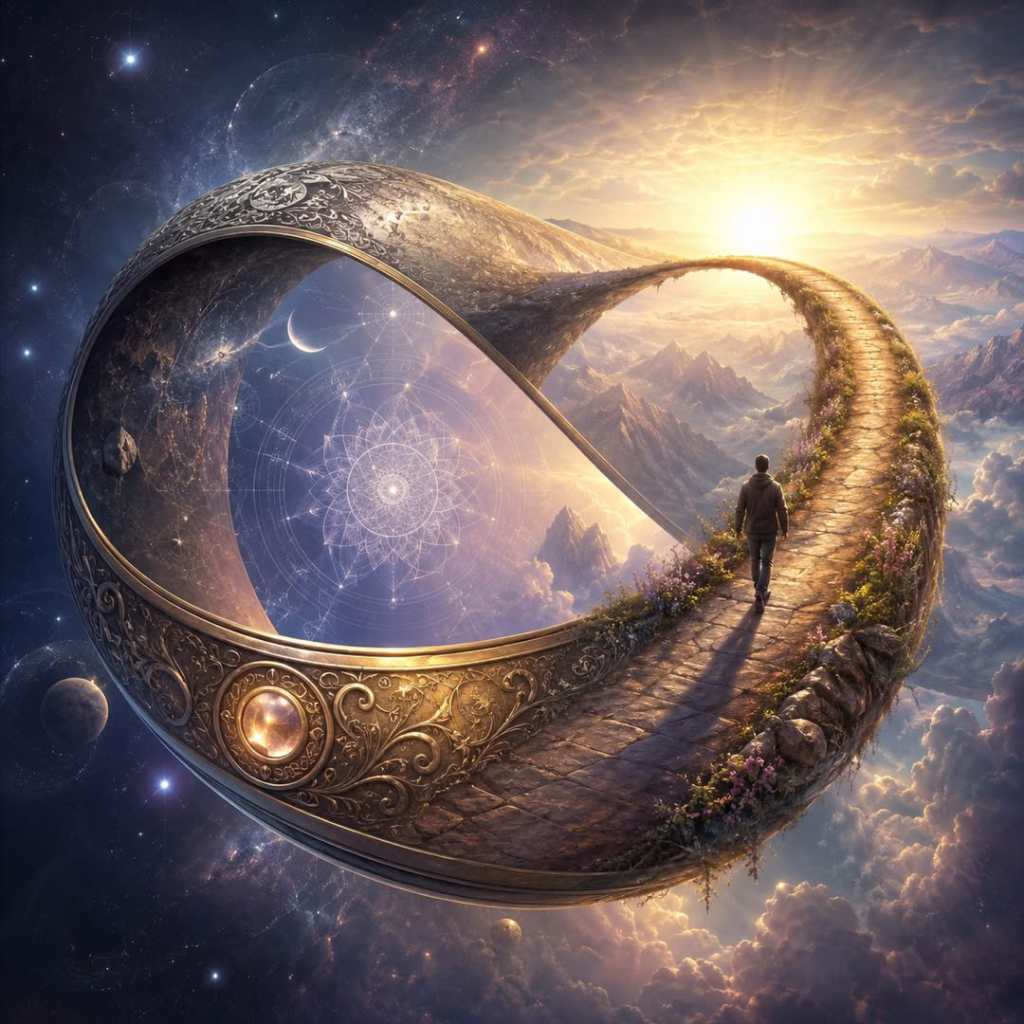
Imagine a ring on your finger. As long as it stays on your finger, it belongs to you. If one day the ring slips into the grass, you can lose it in an instant. That is how many people imagine salvation: as a precious object. Some fear dropping it, others are convinced it cannot be lost. These arguments have gone on for centuries. But Jesus was not talking about a ring. He was talking about a road.
You cannot put a road in your pocket. You cannot receive it once and carry it with you for life. You can only walk it. In Jesus’ words it is almost impossible to find a finish line on earth. He does not say, “Reach this place and the journey will be over.” On the contrary, his words constantly call people back to movement: follow me, abide, keep watch, bear fruit. All of this sounds less like the handing over of a reward than like an invitation to take the next step. The road exists while it is walked.
Salvation has a different meaning. Not “has a person lost salvation?” but “does he continue to walk?” If the traveler stops, the road does not disappear. It still lies ahead of him. He himself has stopped moving. That is the remarkable freedom of Jesus’ teaching. A ring can be lost by accident—one clumsy move and it’s gone. You cannot lose the road by accident. You cannot wake up one morning and find that you accidentally stopped walking the night before. This happens gradually. First the desire to move fades, then the striving for truth weakens, and finally the heart becomes content with the place where it once decided to stop.
But even stopping is rarely final. As long as a person is alive, the road remains before him. The next step can be taken in a day, a year, or decades. That is why Jesus’ way seems far more humane than a constant fear of someday losing something forever. It isn’t a question of losing a valuable object, but of continuing or ceasing the journey. And that choice a person makes not by accident but with his whole life.
Interestingly, the idea of an endless path of development has long appeared in esotericism. It grasped an important truth: human development never ends. Consciousness can grow, the inner life can expand, a new summit always opens ahead. In this regard esotericism perceived something very deep. Yet a simple question arises: if one walks endlessly, where does this road lead?
When development becomes an end in itself, it begins to resemble a ladder set against the void. Each new rung begets the next, each new state demands another state, and development gradually comes to exist for its own sake. The path becomes endless, but its direction remains uncertain.
Jesus does not begin with the road at all, but with the One to whom it leads. God is not simply the highest part of the cosmos or tucked away on some final level of existence. However vast the cosmos, it remains a creation. God is always greater than the cosmos. Therefore the path does not remain unending because the universe is infinite; it is unending because God himself is infinite.
Here we find the distinction between two visions of spiritual development. Esotericism saw movement; Jesus showed the direction. Esotericism saw growth; Jesus explained what that growth is for. Esotericism learned to look inside the person, while Jesus invited people to lift their gaze beyond the person—to the Source of all life.
So an endless path is not the final idea. It is only the beginning. The real question is not how far someone has progressed, but whom they are going toward. As long as the answer is God, the road will never turn into an endless running in circles. Each new step will open not merely a new level of consciousness but a new depth of the One who first became the reason for the path itself. Perhaps this is the chief difference in Jesus’ teaching: infinity is born not from the infinity of the road, but from the infinity of God.













 Follow Jesus Christ
Leave a comment