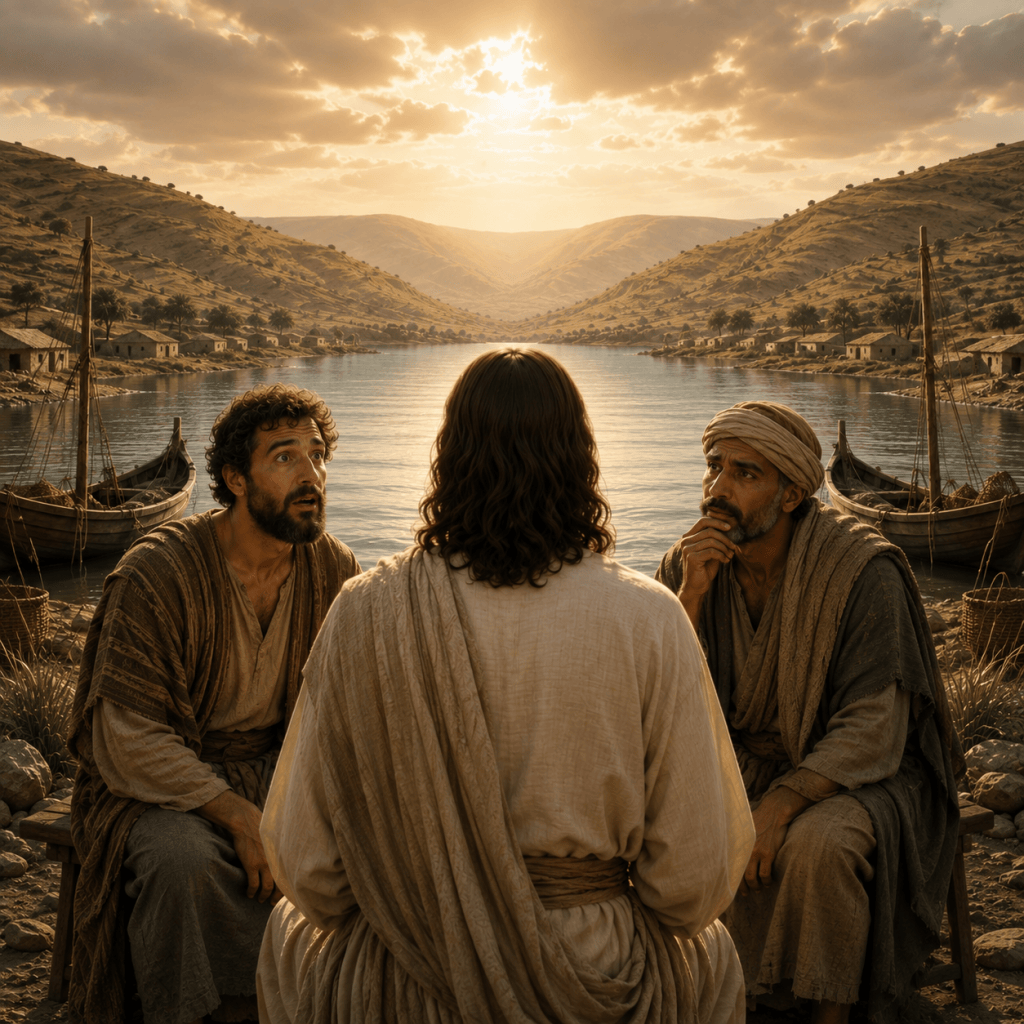
The apostles of Jesus who joined him at the beginning of his ministry believed that Jesus was the Jewish Messiah who would restore Israel’s power over the world. They imagined the Kingdom as a glorified dominion of the Jewish people with the Messiah on David’s throne. They had not signed up to be itinerant preachers who would die violent deaths a few years later. Of course, that fact testifies to the extraordinarily strong spiritual force and energy they had received from Jesus. But how did that turn occur?
The apostles’ misunderstanding persisted astonishingly long—right up to the end. Even before the final journey to Jerusalem, the followers had decided that the earthly kingdom of Jewish supremacy was finally beginning. And even when Jesus told the apostles in the plainest terms that he would be arrested, tried, and killed, they could not psychologically accept the literal meaning of his words. Human psychology is such that personal expectations are often stronger than incoming information. Moreover, even after the resurrection—practically on the eve of the ascension—the apostles again asked Jesus whether he was now going to restore the kingdom!
Clearly, the restructuring of the apostles’ consciousness was not instant. What, then, kept them with Jesus? He often said things they did not understand and shattered the expectations and hopes of his closest disciples. Yet of the twelve only one left him. How was that possible? Year after year Jesus took away almost every element of the future the apostles had imagined. No political revolution. No war with Rome. No throne. No offices. No wealth. No special privileges. Nothing! Instead—roads, other people’s houses, preaching, serving the sick and the poor, constant disputes, growing hostility from the authorities. And yet they stayed.
The main explanation is that the idea for which they had come became less important than the person they had come for. This is a well-known psychological mechanism. At first: “I follow Jesus because I believe in what he will do.” Later: “I follow Jesus because I know who he is.” These are two entirely different motivational systems.
In the first case the relationship is instrumental: I participate in a project for the sake of a future result. In the second case attachment, identification, and a change in one’s value system arise. Jesus ceases to be a means to achieve the Kingdom; he becomes the model of what a human being should be. That is why years of shared life matter so much. They did not simply attend lectures. They ate with him, traveled with him, argued with him, made mistakes, saw him tired, observed his reactions to enemies, to the poor, to women, to children, to the sick, to the rich, to Romans. It was thousands of hours of watching a single person. Such an influence is far stronger than doctrine.
And then everything collapsed. At his arrest and crucifixion they showed no heroism. They were psychologically shattered. It was almost a classic collapse of a worldview. The apostles did not react like fanatics conditioned in advance to die for a movement. They hid. They feared arrest. They even doubted reports of the resurrection. The resurrection pulled them out of despair. They repeatedly met the risen Jesus. But even that proved insufficient for a full transformation. They were finally changed on the day of Pentecost, when the Spirit of God ceased to be merely an idea in their heads and became the lived reality of a person.
The apostles’ transformation moved from the idea “Jesus will defeat all enemies” to the conviction “What I saw in this Man is true regardless of whether he defeats earthly enemies.” That value became so strong that it overrode the instinct for self-preservation. Over three years the apostles grew increasingly attached to Jesus himself and at the same time discovered that his view of God, of humanity, and of religion gave them an altogether different way of being. God ceased to be “the Lord of Israel” and became the Heavenly Father of the individual. Religion became a personal experience rather than primarily a system of observing Jewish laws. Retribution gave way to love of the enemy.
Most importantly, the apostles saw the teaching at work in Jesus himself. If Jesus had only said, “God is your Father,” it would have remained a theological thesis. But the apostles had observed for years a man who lived as if it were true. He taught love of enemies—and did not become a hating person when real enemies appeared. He spoke of trust in the Father—and kept that trust when his own life began to fall apart. He rejected the pursuit of status—and did not use his position to secure privileges. The apostles saw this harmony running through Jesus’ whole life and ultimately wanted to be like him. In psychology this is called identification. Or more simply: friendship and love.
From the standpoint of an ordinary leader, Jesus was actually remarkably poor at “retaining” people. Judged as the leader of a movement, his behavior was sometimes almost anti-recruiting. He told people unpleasant things. He did not promise material rewards. He shattered the apostles’ hopes for political elevation. He did not guarantee safety. He did not try to ease his demands when someone wavered. He allowed people to refuse the invitation to follow him. Jesus kept no one by tricks or manipulation.
Jesus became for the apostles like the sun of life. That said, we should not idealize the situation into the claim “They made the decision completely independently.” People rarely make the most important life decisions in a psychological vacuum. The apostles, alongside Jesus, felt themselves part of something vast, cosmic in scope. Psychologically it became difficult to leave. Nevertheless, there were no manipulations on Jesus’ part.
So Jesus never hid the cost of following him. He did not promise earthly benefits. He did not frighten or pressure his disciples. He did not isolate them from information. Jesus was a personality of genuinely cosmic proportions, an extraordinary being. Such a person inevitably creates an asymmetry of influence. In other words, Jesus possessed influence of enormous power. He persuaded, called, argued, re‑argued, warned, taught, and at times tried insistently to keep people near him—but the final decision he left to the person. God can have an enormously strong impact on human personality without abolishing its freedom. And after a few years the apostles saw themselves entirely transformed, found peace and joy in their new state, and went out to preach to the world. Even death itself ceased to hold the same significance for them.















 Follow Jesus Christ
Leave a comment