
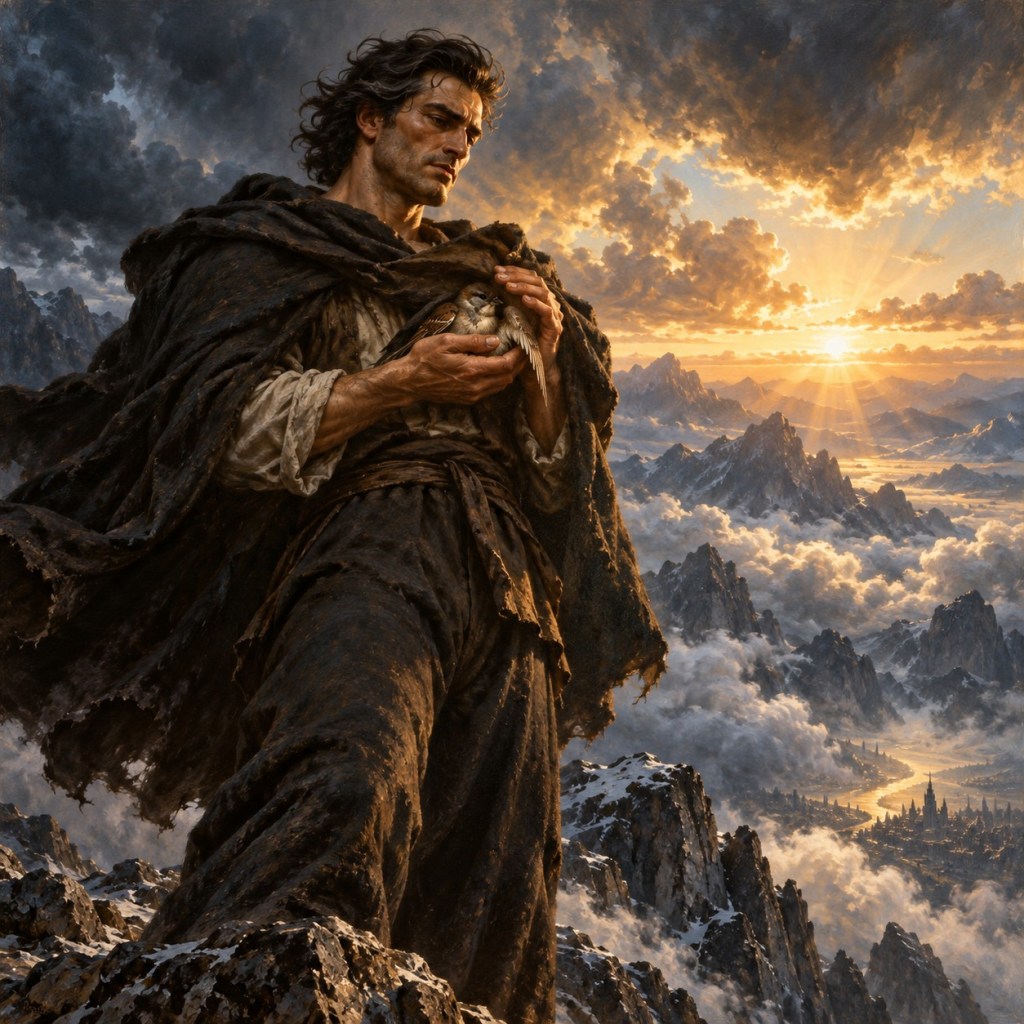
Jesus in no way gave the impression of a man building a religion around death. He was constantly speaking about life, the Kingdom, freedom, trust, growth, fruit, light, children, birds, wildflowers, a feast, a wedding, a found sheep, a returning son, a treasure, new wine. His favorite images are remarkably “alive.”
Historically something almost inevitable happened. Jesus was executed. His followers then had to answer a monstrous question: if he was truly sent by God, why did God allow him to die such a death? Death demanded an explanation. Gradually it ceased to be merely an event at the end of Jesus’ life and became the key to explaining his whole life. And in some forms of Western Christianity there was another step: the cross became not just the climax of the story but almost an optical lens through which everything else is viewed.
What do we have today? A psychological sequence: sin → guilt → judgment → blood → death → forgiveness → salvation. It’s an enormously powerful construct that ancient minds shattered themselves against. But emotionally it is indeed heavy. From many of Jesus’ own words one can build a different sequence: trust → awakening → following → change → love → fruit → increasing life → the Kingdom. The cross doesn’t disappear in that picture. It simply stops obscuring the whole sky.
What if Jesus had not died? Imagine a completely ahistorical scenario: Jesus preaches for twenty or thirty years, trains his disciples, grows old like any person, and one day simply departs. Or maybe he doesn’t age — he simply leaves. I think the religion that grew up around him would have been psychologically very different. Its chief symbol would probably have been the way, not the cross. The central question would not so much be “why did he die for me?” as “where is he calling me to go?” The dominant metaphor might be growth rather than sacrifice; human perfection rather than justification of the guilty; the gaining of fuller life rather than rescue from a sentence. Yet the paradox is that Jesus’ death both darkened his teaching and gave it a colossal, all-consuming force.
If a person says “love your enemies,” that’s a beautiful moral idea. If he says it while safe, it’s philosophy. If he keeps that stance in the face of humiliation, violence and death — that’s a demonstration that his principle stands the ultimate test. We shouldn’t remove the cross. We should only change its place in the structure of belief. The cross can be understood not as the center of gravity and gloom but as the ultimate test of fidelity to life. There is a huge difference between two formulations: “Jesus came to die” and “Jesus came to live in a particular way — and did not abandon that way of life even when the price was death.”
Then Golgotha stops being a black hole that sucks in all of Jesus’ teaching. It becomes one — though terrible — stretch of the road. And in such a model the Resurrection takes on an especially lofty and luminous meaning: the last word is not the cross, not death. Christianity has always understood that latter idea well.
We must not turn Christianity into positive psychology: “smile, God loves you, everything will be fine.” Jesus is far too serious for that. He speaks of loss, fear, hatred, power, wealth, hypocrisy, loneliness, death. But bright does not mean superficial. One can imagine a state that combines lightness, depth, strength and joy. Psychologically this is quite possible. A mature person can fully grasp the tragic nature of existence and yet not be a tragic person. A man condemned to die can, while aware of the tragedy, smile and be well and tastefully dressed.
Here a new reading of Jesus becomes visible. He does not tell people “the world is terrible — be afraid.” Jesus said, “Do not be afraid.” He did not instill in his disciples “you are worthless.” He taught that we are capable of becoming greater than we are now. We can overcome the world. Jesus did not frighten with “hold fast to the right system”; he said, “follow me.” That means living so that even death cannot destroy the meaning of our lives. And then a very different emotional architecture for the future of Christianity appears on the visible horizon: not a religion of death with the promise of life after, but a religion of life that proves stronger than death. To me this distinction precisely captures the desire not to remove Golgotha from Jesus’ story, but to stop letting Golgotha determine the emotional color of all his teaching. And perhaps there is even a splendid image for this. Christianity often portrays Jesus’ journey as though the whole road leads to the cross. But there is another perspective: the road goes through the cross and continues on. That is a very different Christianity. It will be the Christianity of our grandchildren and great-grandchildren.











Leave a Reply