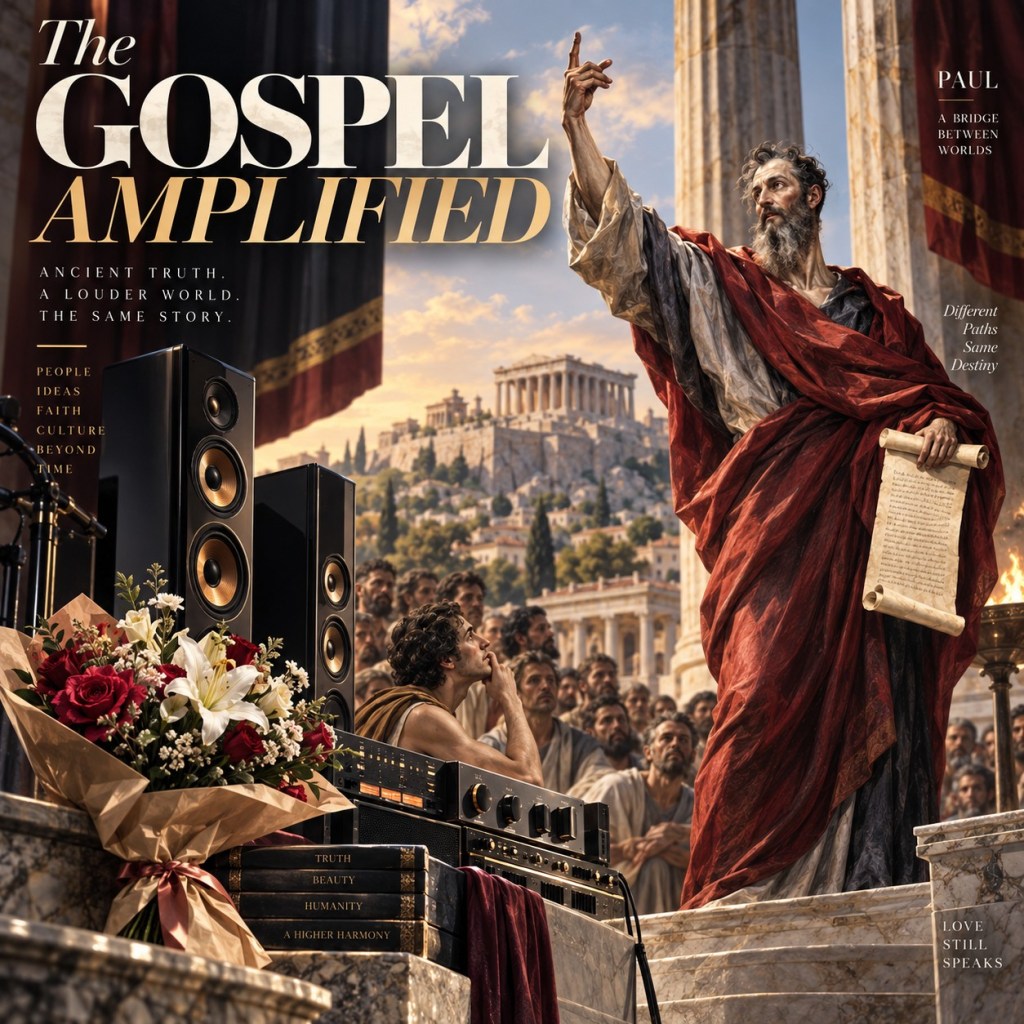
There is a historical puzzle. Jesus speaks of God as Father, teaches trust, sonship, love. But Christianity conquered a huge world in a somewhat different form. At the center of the preaching is no longer only what Jesus taught but Jesus himself: his death, his resurrection, and the meaning of those events for each person. Why did that particular version prove so powerful?
Let’s try a thought experiment. Say to someone: “You are a child of God. God is your Father. Believe this and live as his child.” It sounds beautiful. But where is the proof? The decisive event must take place inside the person’s own consciousness. He has to somehow believe that the invisible God really treats him as a Father.
Now change the message: “Christ died for you and rose. God did something on your behalf. Believe what has been accomplished.” A barely perceptible but extremely important shift occurs. The person is no longer asked to begin with the difficult inner conviction — “I really am God’s child.” First they are shown an event. And here a gift appears.
Imagine a young woman who isn’t sure whether her boyfriend loves her. He can say “I love you” a hundred times. But one day he comes from far away just for her and brings flowers. Flowers don’t create love and they don’t prove it with mathematical certainty. But they make an invisible feeling visible. Now there is something to look at and say: “He did this for me.”
That is probably the psychological function the cross assumed. The abstract “God loves humanity” turns into the intensely personal: “Christ died for you.” Love gets a face, a story, suffering and drama. To a person who finds it hard to believe they are valuable simply because they are God’s child, Golgotha is shown: this is how much you are worth.
But there is another oddity. If God has always been a person’s Father, what exactly changed at the moment of conversion? Yesterday the person didn’t know it, today he does. The Father remained the same. The son remained a son. What changed was belief. For religious consciousness that boundary can seem almost imperceptible.
Paul’s model draws it much more sharply. There is a former life, then an encounter with Christ, faith, baptism — and a new life begins. The person can say: “This is who I was. This is what happened. And this is who I became.” A full drama of transition arises. Human minds love stories that have trouble, a crisis, salvation and a new beginning. And here another metaphor is useful — an amplifier.
Suppose the original signal is extremely simple: “God is your Father.” But the receiver is weak. The person is crushed by guilt, fear, distrust. He hears words about unconditional love but can hardly accept them. Then an amplifier is placed between source and receiver: “Look at Christ. He gave himself for you. After that, can you still not believe that God loves you?” The signal becomes much stronger. Millions hear it.
But every amplifier has a danger: along with the signal it can amplify its own overtones. The initial “God loves you because He is your Father” can gradually become something else: “God is able to accept you because Christ paid for you.” The difference seems small, but already we have two pictures of God. In the first, the cross demonstrates the Father’s love. In the second, the cross becomes the condition of that love.
How could such a shift have happened? Perhaps there was no conscious substitution of the Gospel at all. The first Christians faced a huge problem: if Jesus was truly sent by God, why did the Messiah end up crucified? They had to explain an event that seemed to refute their faith. Jewish culture provided the language of sacrifice, atonement and Scripture. Paul linked those elements into a universal story of salvation.
Something remarkable happened. The strongest argument against the new movement — a crucified Messiah — became its strongest argument. Shame became glory. Defeat became victory. The cross that should have ended Jesus’ story became the main symbol by which that story spread across the world. One must admit: theological precision and spiritual effectiveness are not always the same thing.
A person might think, “Christ died for me. That means God loves me. I trust Christ. I want to belong to God.” His explanation of the mechanism of salvation may be imperfect. But where is his will directed? Toward God. One can be wrong about how salvation works and at the same time truly move toward God.
Seen this way, Paul comes into a somewhat different light. Perhaps he did not simply alter the original signal. Perhaps he built a bridge for people who found it too hard to believe straightaway, “God is my Father.” The teacher says, “God loves you as his child.” The person doesn’t believe. The missionary hands him flowers and says, “Then look at what He has done for you.” The person takes the gift and begins the journey.
And if, at the other end of that journey, he truly discovers the Father, the bridge has done its work — even if one day he must make the final discovery: the Father never demanded a price in order to love his own child.














 Follow Jesus Christ
Leave a comment