Night had fallen over the far country. Outside the walls of a strange city the lights were going out, the wind drove dust along the road, and a man sat where the pigs were fed — the one who had renounced. Once he had a home, a name, a father and a sense of being connected to something larger than himself. Now almost nothing remained. He had left of his own accord, chosen his path, squandered what he’d been given. He had repudiated it all. If there is a point at which a person finally falls out of the Father’s space, it would seem to be here.
But Jesus’ parable ends differently. The father does not gain a new son — he waits for the one who has gone. The son is still far off when the father already sees him. He has not proven his repentance, not restored his reputation, not paid his debts, not even finished his prepared speech of contrition. The father runs out to meet him, as if the outward distance had changed nothing in the deeper, more mysterious realm of their unity. “This son of mine was dead and is alive again; he was lost and is found.” The tie between father and son proves deeper than a man’s visible condition.
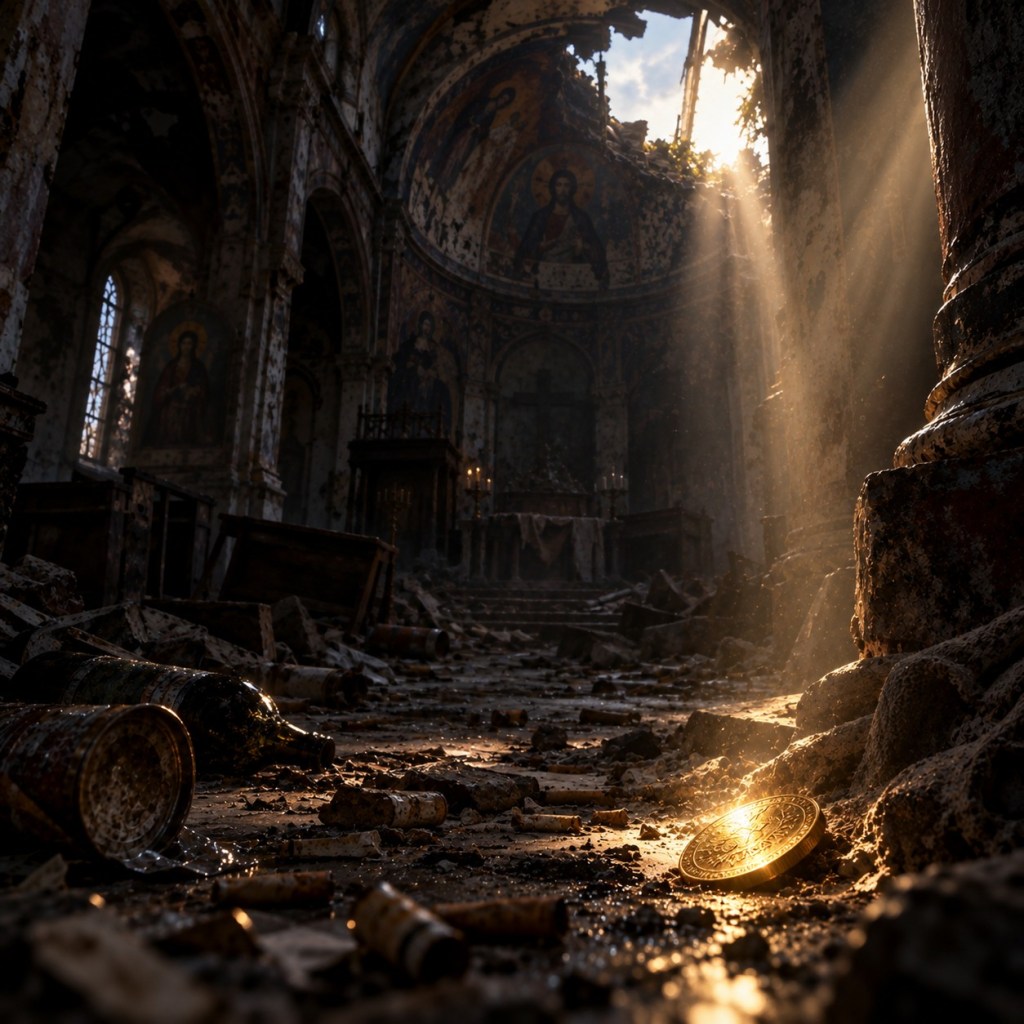
Jesus left two other images as well: the lost sheep and a coin in a dark house. A sheep strays but does not cease to belong to the shepherd. A coin falls from someone’s hand, is covered with dust, disappears from view, but does not lose its value. A woman lights a lamp, and the precious metal begins again to reflect light — just as before. This is not recreation or re-creation: the light does not create the coin’s worth; it only makes visible again what has all along been lying under a layer of dust, in the far corner of the room under the bed.
It is harder to speak of those who consciously choose evil. This is where the usual objection arises: what inner light can there be in a cruel person? What presence of God could remain where someone hates, destroys and deliberately turns against the good? But Jesus says something odd: “The light came into the world, but people loved darkness more than light.” Darkness in this picture does not mean the absence of light. It appears as a reaction to the light. A person can stand in the field of light and still tune his life to an entirely different frequency.
Jesus weeps over Jerusalem: “How often I wanted to gather your children… and you would not.” There is no spiritual programming of the person here. There is a call and a resistance, a flow and a closed channel, a touch and a refusal. God does not break human will. A person can muffle the inner signal for years with fear, hunger for power, hatred, pride and the endless noise of the self. The signal becomes almost inaudible, but the receiver’s silence does not prove that the source has stopped transmitting.
So even enmity with God does not necessarily mean the deepest bond is severed. You can resist only what somehow touches you. The prodigal son built a life opposed to his father’s will, but the far country did not rewrite his origin. He altered the direction of his movement, not the source of his life. Perhaps spiritual catastrophe begins not when God disappears from the depths of a person, but when someone lives against their inner light so long that they lose the ability to discern it.
Every morning Jesus invites us to see this mystery in the most ordinary reality. The sun rises over the houses of the righteous and the wicked, over temples and prisons, over believers and those who long ago shut all doors to God. Rain falls on the just and the unjust. There is no system of spiritual bonuses in this image where “the chosen” or “a superior caste” receive the sun while the rejected remain in the dark. The source emits light always and for everyone — before a person has had time to prove their right to it.
Therefore the command “love your enemies” can be heard as a demand to retune one’s perception. Jesus does not propose calling evil good or abandoning boundaries and justice. He proposes not reducing a person to the level at which they currently live. We see aggression, ideology, addiction, fear, religion, nationality, social mask. But beneath these layers a deeper level of personhood may persist, a depth our ordinary glance simply does not reach.
The most mystical twist comes in the Gospel account of the last judgment. The King says: I was hungry, thirsty, a stranger, sick, in prison. People are astonished because they never met Him. The reply breaks the familiar division between the spiritual and the human: “Whatever you did to one of the least of these, you did to me.” Thus an ordinary encounter between two people may carry a second, invisible layer. We interact with a person only on the surface, but a mysterious impulse of love reaches much deeper.
Then the human face of the person opposite becomes something more than biology, character and social identity. It resembles an interface behind which a much deeper reality is hidden. The interface may be damaged, consciousness filled with noise, the inner channel almost blocked — yet Jesus still warns: be careful with those you consider empty. Perhaps before you stands a closed or temporarily abandoned temple, not an absence of sanctity.
The lost coin lies in the dust, yet still bears its royal image. The son goes to the far country, yet the father continues to feel him as his own. A person shutters the windows, but the sunlight does not vanish from the world. Even one who fights the light may carry within a trace of the Source they have rebelled against. Darkness then becomes not an independent power but a tragedy of consciousness that has learned to live in antiphase with its own deep light.
Perhaps that is why the two greatest commandments of Jesus form not two separate lines but a single spiritual circuit. One directs a person toward the Source, the other toward their neighbor. The flow of life runs from above downward and at the same time from heart to heart. It is impossible to keep searching for God in higher dimensions while ignoring the person standing next to you, because it is the human face that Jesus repeatedly makes the point of contact between the visible and the invisible.
We seek the sacred in the heavens, in temples, in revelations and altered states of consciousness. Perhaps the most difficult spiritual practice is much closer: learning to look at another person and not stop at the surface. Behind the noise there may be a signal, behind the darkness a closed window, beyond the far country a road home. The two commandments point in different directions but are connected to the same Source. Whoever loves God also loves all people.










 Follow Jesus Christ
Leave a comment