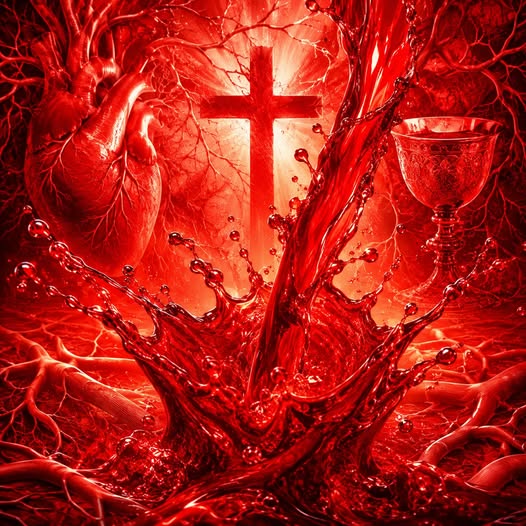
If the blood of Jesus by itself saves a person, why did Jesus speak so much about following him, repentance, being born again, loving your enemies, taking up your cross, and doing the Father’s will? In Jesus’ teaching salvation is almost always linked to a change in the person, not to accepting a particular theory of atonement. In fact, the blood of Jesus is not a magical substance that automatically saves someone by “washing” them from the outside.
Many picture redemption as if Jesus’ blood simply washes away sins like water rinsing dirt from clothes. But if one looks at Jesus’ own teaching, a different image emerges.
Blood is life. In ancient thought blood symbolized a person’s life-force. When Jesus shed his blood, he gave people not just a body but his whole life: his fidelity to God, his courage, his love, his compassion, his willingness to forgive and to serve others. Jesus did not shed his blood to wash us externally; he did it so that his life might flow within us.
A doctor does not heal a patient by smearing blood over his body. Healing happens when new blood begins to flow through a person’s veins. The same is true spiritually. A person does not change simply by acknowledging the historical fact of the crucifixion. He changes when the spirit of Jesus becomes part of his own life.
In that sense “accepting the blood of Christ” means accepting his character. His blood begins to flow in our spiritual veins when we learn to love as he loved, forgive as he forgave, and trust God as he trusted him. Then the whole inner structure of a person gradually changes. Every Sunday in church, when Christians partake of Communion, they are contemplating precisely these symbols.
This understanding echoes Jesus’ words about the vine and the branches: “Abide in me, and I in you.” He is not talking about a legal transaction. He is speaking of life joined to life. The sap of the vine flows into the branches. The life of Christ flows into the disciple. That is why fruit appears.
The blood of Jesus is not a substitute for our spiritual growth, nor is it a mystical fee paid to God. It is the source of that spiritual growth. And if there is no growth, then, deep down in the heart, the blood of Christ has been rejected. The saving blood of Christ is his life, his spirit, his character—what gradually becomes our own life.
Salvation is not a one-time legal deal but a transfusion of new life. The old self gradually dies, and within it a new person is born, in whom Christ becomes increasingly visible. This is what Paul meant when he wrote, “I have been crucified with Christ; and it is no longer I who live, but Christ lives in me.”
In the sixth chapter of the Gospel of John Jesus says, “Unless you eat the flesh of the Son of Man and drink his blood, you have no life in you.” Taken literally, these words pose serious difficulties. The Jews had been raised under a prohibition against consuming blood. That is why many of his listeners were scandalized by his words and rejected them as heretical.
But shortly afterward Jesus adds: “The Spirit gives life; the flesh is of no avail. The words that I have spoken to you are spirit and life.” This opens the way to understanding “eat” and “drink” as deep internal assimilation.
When a person eats bread, the bread becomes part of his body. When he drinks water, the water enters him and sustains life. By this logic Jesus’ words can be rephrased: “Do not simply admire me. Do not merely listen to me. Make my life your life. Internalize my spirit as deeply as food and drink are assimilated by the body. Why do you keep calling me ‘Lord, Lord,’ and not do what I say?”
The image of blood carries this meaning: blood distributes life throughout the body. If “to drink the blood of Christ” is taken symbolically, it can mean accepting his mindset, his love, his attitude toward God and toward people. It means not observing that life from the outside but making it your own.
The reality of the Gospel narrative itself says that the shed blood is the life Jesus gave entirely; to drink the blood is to take that life into oneself; salvation is the gradual transformation of a person by that life.
Read this way, Jesus is not speaking of a juridical mechanism of atonement, nor of an ancient, outdated way of understanding the relationship between God and humanity by means of sacrifice and “sprinkling of blood.” He is speaking of a deep union of the life of the Teacher and the disciple. The blood of Christ saves not because it was spilled on the ground—that would be wasteful and absurd—but because it begins to flow in the heart of a person when that person takes the spirit of Jesus as his way of life.
For many people the cross has become the symbol of salvation. But the cross by itself does not save either. The cross was an instrument of execution, a scene of human cruelty, suffering, humiliation, and death. Viewed only from the outside, Golgotha looks less like a triumph than like a tragedy.
And yet something happened there that changed the course of human history. On the cross Jesus did not merely die; to the end he kept his fidelity to truth, to love, and to God. He did not answer hatred with hatred, violence with violence, or curse with curse. Even amid pain and injustice he continued to love. His blood became the symbol of that life given fully for the highest purpose.
Thus the cross should not be understood as a magical object or a legal mechanism of salvation. Golgotha is the place where Jesus’ life was poured out into the world. His blood was shed not to remain on the ground but to enter human hearts. It is like new life flowing through the spiritual veins of those who decide to follow his way. It is not the wood of the cross and not the mere fact of execution that saves, but the life Jesus gave people through his fidelity, love, and sacrifice.
But the story does not end there. If the blood of Jesus flows in our hearts, then Golgotha ceases to be only his story and becomes our own. Sooner or later everyone meets his own cross — a moment when one must choose between convenience and conscience, between safety and truth, between personal advantage and love. It is then that we learn whether we have taken the life of Christ into ourselves. The cross not only reminds us of what Jesus did. It reminds us of what each of us may be called to do. And if needed, to give one’s life—not necessarily physically, but through service, faithfulness, self-sacrifice, and love—for something greater than ourselves.













 Follow Jesus Christ
Leave a comment