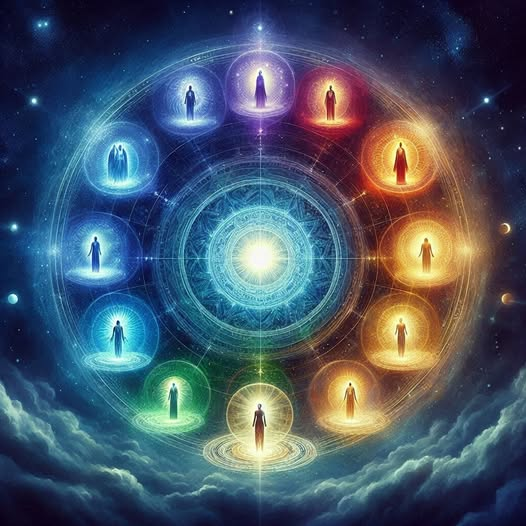
Close followers and disciples of Jesus belonged to the “club of the thirsty.” Jesus admitted to his inner circle those who demonstrated a thirst for truth—spiritual “buyers” seeking spiritual values. These people seek connection with the Absolute, feel an inner calling, and cannot conceive of existence without God. They are ready to pay a high price for access to the mysteries of the spiritual world, up to and including the price of their own lives.
The psychology of religion places mystics and emotionally driven people close to this category—those inclined to worship beauty and capable of empathy. Mystically gifted people experience the spiritual directly, without dogma; they have an intuitive nature and heightened sensitivity to exalted ideas and images. Those who feel beauty particularly keenly are more likely to follow a religion of the heart than a religion of the mind. They strive for a state of spiritual joy and delight in elevated aesthetics.
Next come, probably, the “philosophers of religion” who try to understand God as an idea, as a person, or otherwise. They analyze the structure of reality; they are curious and combine rationality with metaphysics. For such people religion is more intellectual contemplation than cult. They too seek truth, but more in the mind than in the heart. This group includes various kinds of free thinkers who reassess religion from their own perspectives, like Leo Tolstoy and all the “people without churches.”
On the next, lower level are those who see religion as order and absolute necessity. They seek stability, reliable frameworks, and social belonging. They do not want to see chaos and feel a need for clear rules and traditions. As a rule, these people are dependable traditionalists, conservatives, institutional believers. For them religion is a spiritual, moral, and cultural framework. They form the backbone of all religions without exception, even Christianity.
Roughly at the same level are militant or ideologically driven believers. Their main motive is asserting their own rightness, fighting for the purity of faith. They project their aggression into religious form. Accordingly, many of them are fanatics, religious nationalists, or followers of quasi-religious ideologies. Their mechanism is force and fear, and essentially they are just striving for power in the name of good intentions.
At the lowest level are those who fear failing to observe religious traditions—the representatives of a religion of fear. They try to avoid punishment, guilt, or curses; they are anxious and dependent on various authorities. Their faith is obsessive, childishly naive, and sometimes literal. God for them is most likely a stern and merciless judge or overseer. Add to this the infantile believers who pin their hopes on magic and miracles. Inclined toward childish thinking and magical causality, they ask God for wonders and signs. For them religion is more a way to have their own wishes fulfilled.
But these states should not be assumed to be static. The fact is they are all in the process of growth and are oddly intertwined in a person’s life. For example, at certain moments belief in amulets may “switch on,” even if a person is an absolutely convinced spiritual seeker. A spiritual seeker may intensely experience the sense of the beautiful, mystical spiritual states, or the desire to seize political power. This sometimes happens unconsciously. However, spiritual growth proceeds from the bottom up—from a religion of fear to a state of readiness to sacrifice one’s life for love. Life shows that regression is possible: a person can move down to a lower level. Stagnation is also possible, when a person remains on one rung.
One should not assume that salvation lies simply in being on the highest floor. Rather, it is spiritual growth itself that saves—that is, progress, the ability to ascend regardless of where one began. These states are very often unconscious and escape self-analysis. Still, it should be acknowledged that when spiritual growth reaches a certain threshold, a person will have the opportunity to enter a narrow, initiated spiritual circle.














Leave a Reply